
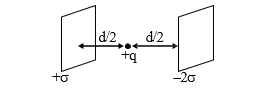
Consider two infinitely large plane parallel conducting plates as shown below. The plates are uniformly charged with a surface charge density and . The force experienced by a point charge placed at the mid point between the plates will be:
- A
- B
- C
- D
Consider two infinitely large plane parallel conducting plates as shown below. The plates are uniformly charged with a surface charge density and . The force experienced by a point charge placed at the mid point between the plates will be:
Correct answer:B
Standard Method
Given: Two infinitely large parallel conducting plates with surface charge densities and are shown, and a point charge is placed at the midpoint.
Find: The force on the charge .
Use superposition of electric fields due to the two infinite plates.
For the left positively charged plate, the field at the midpoint is away from the plate:
For the right negatively charged plate of magnitude , the field at the midpoint is towards the plate:
Both fields are in the same direction, so
Hence the force on the positive charge is
Therefore, the correct option is B and the force is , directed towards the plate with charge density .
Note: The question text/options mention , but the solution and diagram clearly use . The answer has been derived from the solution, which is the primary source.
Field Direction Analysis
Given: A positive sheet on the left and a negative sheet of magnitude on the right, with at the midpoint.
Find: Net force on .
Step 1: Electric field due to an infinite sheet has magnitude
Step 2: Determine directions.
Step 3: Add magnitudes because both fields are parallel and in the same direction:
Step 4: Force on a positive charge has the same direction as the electric field:
So the magnitude is
Thus, the force acts to the right, towards the negatively charged plate, and the correct option is B.
Using the field of an infinite sheet as for each plate. That value is not for a single isolated sheet here; for each infinite sheet the magnitude at either side is . First find each plate's field correctly, then add them.
Missing the sign and direction of the electric field. The field due to a positive plate is away from it, while the field due to a negative plate is towards it. At the midpoint both fields point in the same direction, so they add rather than cancel.
Assuming the two given surface charge densities are equal in magnitude because of the typed question text. The diagram and solution use the right plate as , which changes the result. Always check the figure and solution authority when the has a mismatch.
Get unlimited AI-adaptive practice, mastery tracking, and an AI tutor that explains every step — free to start.