
Which one of the following reaction sequences will give an azo dye?
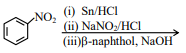
- A
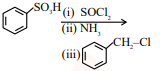
- B
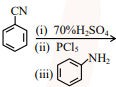
- C
- D
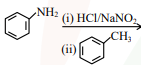
Which one of the following reaction sequences will give an azo dye?
Correct answer:A
Standard Method
Given: We need to identify which reaction sequence gives an azo dye.
Find: The correct option corresponding to azo dye formation.
An azo dye is formed through diazotization of a primary aromatic amine followed by coupling with an activated aromatic compound such as -naphthol.
The required sequence is:
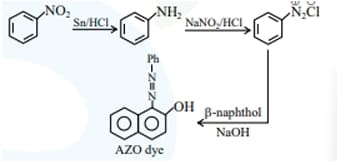
Thus, the correct reaction sequence is option A.
Reaction Logic
Given: Azo dyes are obtained from aromatic diazonium salts by coupling reactions.
Find: Which sequence contains all necessary steps.
For azo dye formation, the substrate must first provide a primary aromatic amine. If the starting compound contains a nitro group, it must be reduced:
Then the amine is diazotized:
Finally, coupling with -naphthol in alkaline medium gives the azo dye:
Only option A shows this complete sequence.
Confusing diazotization with any reaction of an aromatic amine. Azo dye formation specifically requires formation of an aryl diazonium salt first, then coupling with an activated aromatic ring such as -naphthol.
Ignoring the need to reduce to before diazotization. A nitro group does not undergo diazotization directly; it must first be converted into a primary aromatic amine.
Choosing a sequence that lacks a proper coupling component. Even after diazonium salt formation, an azo dye is obtained only when it reacts with an activated aromatic compound like -naphthol in alkaline medium.
Get unlimited AI-adaptive practice, mastery tracking, and an AI tutor that explains every step — free to start.