
Match List-I with List-II.
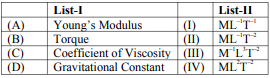
Choose the correct answer from the options given below:
- A
(A)-(I), (B)-(III), (C)-(I), (D)-(II)
- B
(A)-(II), (B)-(IV), (C)-(II), (D)-(III)
- C
(A)-(III), (B)-(I), (C)-(IV), (D)-(II)
- D
(A)-(I), (B)-(II), (C)-(I), (D)-(IV)
Match List-I with List-II.
Choose the correct answer from the options given below:
(A)-(I), (B)-(III), (C)-(I), (D)-(II)
(A)-(II), (B)-(IV), (C)-(II), (D)-(III)
(A)-(III), (B)-(I), (C)-(IV), (D)-(II)
(A)-(I), (B)-(II), (C)-(I), (D)-(IV)
Correct answer:D
Standard Method
Given: Match the physical quantities in List-I with the dimensional formulas in List-II.
Find: The correct matching and hence the correct option.
Use dimensional analysis for each quantity.
For Young's Modulus:
Since strain is dimensionless,
So, (A) (I).
For Torque:
So, (B) (II).
For Coefficient of Viscosity: Using
we get
So, (C) (I).
For Gravitational Constant: From Newton's law of gravitation,
Hence,
and therefore
So, (D) (IV).
Therefore, the final matching is (A)-(I), (B)-(II), (C)-(I), (D)-(IV). The correct option is D.
Step-by-Step Matching
Given: Four physical quantities are to be matched with their dimensional formulas.
Find: The correct correspondence.
Hence, (A) (I).
Hence, (B) (II).
we get
Hence, (C) (I).
Hence, (D) (IV).
So the required match is (A)-(I), (B)-(II), (C)-(I), (D)-(IV), which corresponds to option D.
Confusing stress with force while finding Young's modulus is incorrect because Young's modulus is stress/strain, not force directly. Always divide force by area first, then note that strain is dimensionless.
Using the dimension of work incorrectly for torque without checking the derivation can cause errors in matching. Although torque and work have the same dimensions, here you should compute it directly as force × distance to avoid mismatch.
Taking the velocity gradient as dimensionless is wrong because it has dimension . For viscosity, first write force per unit area, then divide by the velocity gradient carefully.
Get unlimited AI-adaptive practice, mastery tracking, and an AI tutor that explains every step — free to start.