MCQEasyJEE 2025Capacitors & Dielectrics

JEE Physics 2025 Question with Solution

A capacitor, C1=6μFC_1 = 6 \, \mu F, is charged to a potential difference of V1=5VV_1 = 5 \, V using a 5V5V battery. The battery is removed and another capacitor, C2=12μFC_2 = 12 \, \mu F, is inserted in place of the battery. When the switch 'S' is closed, the charge flows between the capacitors for some time until equilibrium condition is reached. What are the charges q1q_1 and q2q_2 on the capacitors C1C_1 and C2C_2 when equilibrium condition is reached?
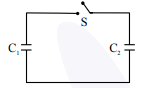
Circuit diagram showing two capacitors C1 and C2 connected in parallel with a switch S on the top branch.
  • A

    q1=15μC,q2=30μCq_1 = 15 \, \mu C, \, q_2 = 30 \, \mu C

  • B

    q1=30μC,q2=15μCq_1 = 30 \, \mu C, \, q_2 = 15 \, \mu C

  • C

    q1=10μC,q2=20μCq_1 = 10 \, \mu C, \, q_2 = 20 \, \mu C

  • D

    q1=20μC,q2=10μCq_1 = 20 \, \mu C, \, q_2 = 10 \, \mu C

Answer

Correct answer:C

Step-by-step solution

Standard Method

Given: C1=6μFC_1 = 6 \, \mu F, C2=12μFC_2 = 12 \, \mu F, and the initial potential across C1C_1 is V1=5VV_1 = 5 \, V.

Find: The final charges q1q_1 and q2q_2 after the switch is closed and equilibrium is reached.

Initially, capacitor C1C_1 has charge

qinitial=C1V1=6μF×5V=30μCq_{\text{initial}} = C_1 V_1 = 6 \, \mu F \times 5 \, V = 30 \, \mu C

After the battery is removed and the switch is closed, the two capacitors are effectively connected in parallel. At equilibrium, both capacitors have the same potential difference. Let this common potential be VcV_c.

Then

q1=C1Vcq_1 = C_1 V_c

and

q2=C2Vcq_2 = C_2 V_c

Using conservation of total charge,

q1+q2=30μCq_1 + q_2 = 30 \, \mu C

Substituting,

C1Vc+C2Vc=30μCC_1 V_c + C_2 V_c = 30 \, \mu C Vc(C1+C2)=30μCV_c (C_1 + C_2) = 30 \, \mu C

So,

Vc=30μC6μF+12μF=3018=1.67VV_c = \frac{30 \, \mu C}{6 \, \mu F + 12 \, \mu F} = \frac{30}{18} = 1.67 \, V

Now calculate the final charges:

q1=C1Vc=6μF×1.67V=10μCq_1 = C_1 V_c = 6 \, \mu F \times 1.67 \, V = 10 \, \mu C q2=C2Vc=12μF×1.67V=20μCq_2 = C_2 V_c = 12 \, \mu F \times 1.67 \, V = 20 \, \mu C

Therefore, the final charges are q1=10μCq_1 = 10 \, \mu C and q2=20μCq_2 = 20 \, \mu C. The correct option is C.

Charge Conservation with Common Final Voltage

Given: C1=6μFC_1 = 6 \, \mu F, C2=12μFC_2 = 12 \, \mu F, V1=5VV_1 = 5 \, V.

Find: The equilibrium charges on both capacitors.

First, compute the initial charge on the charged capacitor:

Q1=C1V1=6×5=30μCQ_1 = C_1 V_1 = 6 \times 5 = 30 \, \mu C

Initially, the second capacitor is uncharged, so

Q2=0Q_2 = 0

Hence the total charge available in the isolated two-capacitor system is

Qtotal=Q1+Q2=30μCQ_{\text{total}} = Q_1 + Q_2 = 30 \, \mu C

When the switch is closed, both capacitors are connected in parallel, so their final potential difference is the same. Let this common voltage be VfV_f.

Then the total charge becomes

Qtotal=(C1+C2)VfQ_{\text{total}} = (C_1 + C_2)V_f

Substitute the given values:

30=(6+12)Vf30 = (6 + 12)V_f 30=18Vf30 = 18V_f Vf=3018=53VV_f = \frac{30}{18} = \frac{5}{3} \, V

Now find the charge on each capacitor:

q1=C1Vf=6×53=10μCq_1 = C_1 V_f = 6 \times \frac{5}{3} = 10 \, \mu C q2=C2Vf=12×53=20μCq_2 = C_2 V_f = 12 \times \frac{5}{3} = 20 \, \mu C

Verification:

q1+q2=10+20=30μCq_1 + q_2 = 10 + 20 = 30 \, \mu C

which matches the initial total charge.

Therefore, the final answer is q1=10μCq_1 = 10 \, \mu C and q2=20μCq_2 = 20 \, \mu C. The correct option is C.

Common mistakes

  • Assuming the final charge on each capacitor becomes equal is incorrect. In parallel, the voltage becomes equal at equilibrium, not the charge. Use q=CVq = CV for each capacitor after finding the common final voltage.

  • Forgetting conservation of total charge after removing the battery leads to a wrong result. Once the battery is removed, the isolated capacitor system redistributes the existing charge, so the total remains 30μC30 \, \mu C.

  • Using series-capacitor rules is incorrect here. After the switch is closed, both capacitors share the same two nodes, so they are in parallel and must have the same final potential difference.

Practice more Capacitors & Dielectrics questions

Get unlimited AI-adaptive practice, mastery tracking, and an AI tutor that explains every step — free to start.

Related questions