MCQMediumJEE 2025Centre of Mass

JEE Physics 2025 Question with Solution

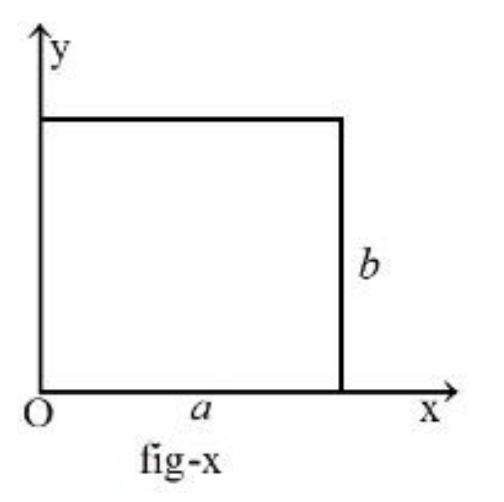
The center of mass of a thin rectangular plate (fig - x) with sides of length aa and bb, whose mass per unit area (σ\sigma) varies as σ=σ0xab\sigma = \sigma_0 \frac{x}{ab} (where σ0\sigma_0 is a constant), would be

A rectangular plate in the first quadrant with origin O at the lower left corner, horizontal x-axis, vertical y-axis, base labeled a, and right side labeled b.
  • A

    (23a,23b)\left(\frac{2}{3} a, \frac{2}{3} b\right)

  • B

    (13a,12b)\left(\frac{1}{3} a, \frac{1}{2} b\right)

  • C

    (12a,12b)\left(\frac{1}{2} a, \frac{1}{2} b\right)

  • D

    (23a,12b)\left(\frac{2}{3} a, \frac{1}{2} b\right)

Answer

Correct answer:D

Step-by-step solution

Standard Method

Given: A thin rectangular plate occupies 0xa0 \le x \le a and 0yb0 \le y \le b. Its surface mass density is

σ=σ0xab\sigma = \frac{\sigma_0 x}{ab}

Find: The coordinates of the center of mass (xcm,ycm)\left(x_{cm}, y_{cm}\right).

The total mass is

M=σdA=0a0bσ0xabdydxM = \iint \sigma \, dA = \int_0^a \int_0^b \frac{\sigma_0 x}{ab} \, dy \, dx =σ0ab0ax(0bdy)dx=σ0ab0axbdx= \frac{\sigma_0}{ab} \int_0^a x \left(\int_0^b dy\right) dx = \frac{\sigma_0}{ab} \int_0^a xb \, dx =σ0a0axdx=σ0aa22=σ0a2= \frac{\sigma_0}{a} \int_0^a x \, dx = \frac{\sigma_0}{a} \cdot \frac{a^2}{2} = \frac{\sigma_0 a}{2}

Now,

xcm=1MxσdA=1M0a0bxσ0xabdydxx_{cm} = \frac{1}{M} \iint x\sigma \, dA = \frac{1}{M} \int_0^a \int_0^b x \cdot \frac{\sigma_0 x}{ab} \, dy \, dx =2σ0aσ0ab0ax2(0bdy)dx= \frac{2}{\sigma_0 a} \cdot \frac{\sigma_0}{ab} \int_0^a x^2 \left(\int_0^b dy\right) dx =2σ0aσ0ab0ax2bdx=2a20ax2dx= \frac{2}{\sigma_0 a} \cdot \frac{\sigma_0}{ab} \int_0^a x^2 b \, dx = \frac{2}{a^2} \int_0^a x^2 \, dx =2a2a33=2a3= \frac{2}{a^2} \cdot \frac{a^3}{3} = \frac{2a}{3}

Similarly,

ycm=1MyσdA=1M0a0byσ0xabdydxy_{cm} = \frac{1}{M} \iint y\sigma \, dA = \frac{1}{M} \int_0^a \int_0^b y \cdot \frac{\sigma_0 x}{ab} \, dy \, dx =2σ0aσ0ab0ax(0bydy)dx= \frac{2}{\sigma_0 a} \cdot \frac{\sigma_0}{ab} \int_0^a x \left(\int_0^b y \, dy\right) dx =2a2b0axb22dx=ba20axdx= \frac{2}{a^2 b} \int_0^a x \cdot \frac{b^2}{2} \, dx = \frac{b}{a^2} \int_0^a x \, dx =ba2a22=b2= \frac{b}{a^2} \cdot \frac{a^2}{2} = \frac{b}{2}

Therefore, the coordinates of the center of mass are (2a3,b2)\left(\frac{2a}{3}, \frac{b}{2}\right). Hence, the correct option is D. The provided answer key and the listed the solution indicating A disagree with the worked integration, but the solution working gives option D.

Using symmetry in the y-direction

Given: The density varies only with xx as

σ=σ0xab\sigma = \sigma_0 \frac{x}{ab}

so along the vertical direction the plate is uniformly distributed for each fixed xx.

Find: xcmx_{cm} and ycmy_{cm}.

Because the density depends only on xx and not on yy, the mass distribution is symmetric about the horizontal line y=b2y = \frac{b}{2}. Therefore,

ycm=b2y_{cm} = \frac{b}{2}

For the xx-coordinate, use weighted averaging:

M=σdA=σ0a2M = \iint \sigma \, dA = \frac{\sigma_0 a}{2}

and

xcm=1MxσdA=2a3x_{cm} = \frac{1}{M} \iint x\sigma \, dA = \frac{2a}{3}

Thus,

(xcm,ycm)=(2a3,b2)\left(x_{cm}, y_{cm}\right) = \left(\frac{2a}{3}, \frac{b}{2}\right)

So the correct option is D.

Common mistakes

  • Assuming the plate is uniform and taking the center of mass at (a2,b2)\left(\frac{a}{2}, \frac{b}{2}\right) is incorrect because the surface density depends on xx. The mass is greater near larger xx, so the center shifts right. Always weight the coordinates by σ\sigma.

  • Using ycm=2b3y_{cm} = \frac{2b}{3} is wrong because the density does not vary with yy. Since the distribution is uniform along the vertical direction, the correct vertical coordinate remains the midpoint b2\frac{b}{2}.

  • Computing total mass without the factor xx from the density expression leads to an incorrect normalization. First find M=σdAM = \iint \sigma \, dA correctly, then divide the moments by this total mass.

Practice more Centre of Mass questions

Get unlimited AI-adaptive practice, mastery tracking, and an AI tutor that explains every step — free to start.

Related questions