MCQEasyJEE 2025Capacitors & Dielectrics

JEE Physics 2025 Question with Solution

Two capacitors C1C_1 and C2C_2 are connected in parallel to a battery. Charge-time graph is shown below for the two capacitors. The energy stored with them are U1U_1 and U2U_2, respectively. Which of the given statements is true?
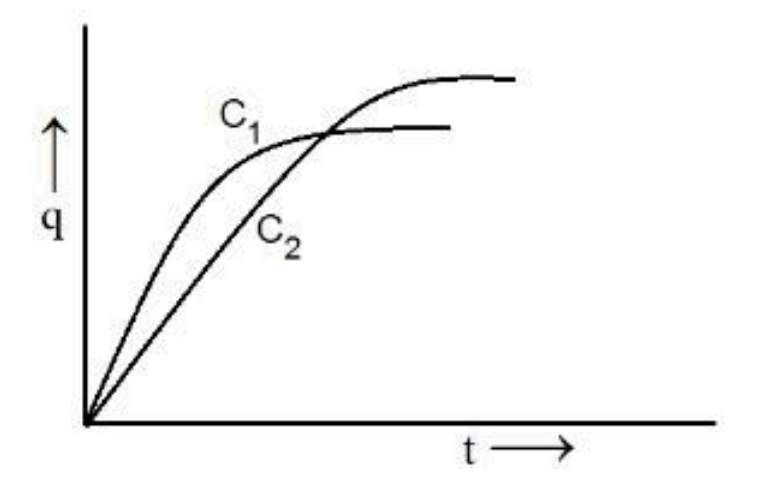
Charge versus time graph for two capacitors in parallel, with vertical axis q and horizontal axis t, showing curve C1 rising faster but saturating lower than C2, while C2 rises more slowly and reaches a higher final charge.
  • A

    C1>C2,U1<U2C_1 > C_2, U_1 < U_2

  • B

    C2>C1,U2>U1C_2 > C_1, U_2 > U_1

  • C

    C2>C1,U2<U1C_2 > C_1, U_2 < U_1

  • D

    C1>C2,U1>U2C_1 > C_2, U_1 > U_2

Answer

Correct answer:B

Step-by-step solution

Standard Method

Given: Two capacitors C1C_1 and C2C_2 are connected in parallel to a battery, so both have the same potential difference VV. The charge-time graph shows that capacitor C2C_2 reaches a higher final charge than capacitor C1C_1.

Find: The correct relation between capacitances and energies U1U_1 and U2U_2.

For capacitors connected in parallel,

Q=CVQ = CV

At the same voltage, the capacitor with greater final charge has greater capacitance. From the graph,

Q2>Q1Q_2 > Q_1

Therefore,

C2>C1C_2 > C_1

The energy stored in a capacitor is

U=12CV2U = \frac{1}{2}CV^2

Since both capacitors have the same voltage VV, energy is directly proportional to capacitance. Hence,

U2>U1U_2 > U_1

Therefore, the correct option is B: C2>C1,U2>U1C_2 > C_1, U_2 > U_1.

Note: The extracted solution text on the page contains an internal inconsistency with the displayed graph; the graph and the marked correct option both support option B.

Common mistakes

  • Looking at the initial charging rate instead of the final charge. The final charge determines capacitance here because both capacitors are connected across the same battery voltage. Compare the saturation values of qq, not only the early-time slope.

  • Using the wrong graph interpretation and concluding C1>C2C_1 > C_2. That would be true only if Q1>Q2Q_1 > Q_2 at steady state. From the graph, the final charge of C2C_2 is higher, so C2>C1C_2 > C_1.

  • Assuming energy depends on charge alone without using the same-voltage condition. Since both are in parallel, use U=12CV2U = \frac{1}{2}CV^2 with common VV, so the larger capacitance stores more energy.

Practice more Capacitors & Dielectrics questions

Get unlimited AI-adaptive practice, mastery tracking, and an AI tutor that explains every step — free to start.

Related questions