MCQMediumJEE 2025Prisms & Total Internal Reflection
JEE Physics 2025 Question with Solution
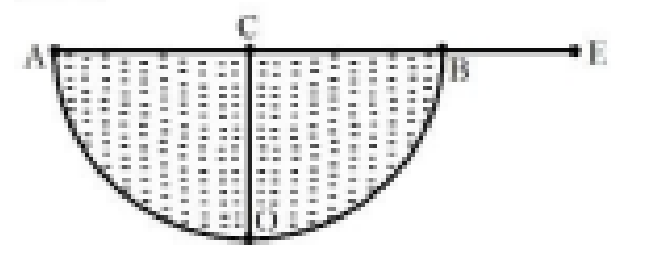
A hemispherical vessel is completely filled with a liquid of refractive index μ. A small coin is kept at the lowest point O of the vessel as shown in the figure. The minimum value of the refractive index of the liquid so that a person can see the coin from point E (at the level of the vessel) is:
A
2
B
23
C
3
D
23
Answer
Correct answer:A
Step-by-step solution
Standard Method
Given: A hemispherical vessel is completely filled with a liquid of refractive index μ. A coin is at the lowest point O, and the observer is at point E at the level of the vessel.
Find: The minimum value of μ for which the coin is visible from E.
For the coin to be just visible from E, the emergent ray at the liquid surface must travel horizontally. Hence the angle of refraction is 90∘, and the angle of incidence at the surface is the critical angle.
Using Snell's law at the liquid-air interface:
μsinθi=1⋅sin90∘
So,
μsinθi=1sinθi=μ1
Now use the geometry of the hemisphere. The limiting ray goes from O to the rim point and forms a right triangle in which the relevant ratio is
sinθi=R2R=21
Equating the two expressions for sinθi:
μ1=21
Therefore,
μ=2
Thus, the minimum refractive index of the liquid for the coin to be visible from E is 2. Therefore, the correct option is A.
Critical Angle Interpretation
Given: The observer is at the same level as the top surface of the hemispherical vessel.
Find: The least refractive index for visibility.
The minimum refractive index corresponds to the limiting condition of visibility. In that case, the refracted ray grazes the surface, so the refracted angle becomes 90∘.
Hence the incident angle inside the liquid equals the critical angle θc, where
sinθc=μ1
From the geometry shown, the limiting ray makes an angle such that
sinθc=21
Therefore,
μ1=21μ=2
So the least value of the refractive index is 2.
Common mistakes
Using ordinary refraction instead of the critical condition. For the minimum refractive index, the emergent ray must be horizontal, so the refracted angle is 90∘. Start with the critical-angle relation, not an arbitrary refracted angle.
Taking the wrong trigonometric ratio from the geometry. The solution uses the limiting ray geometry to get sinθi=21. If the triangle is identified incorrectly, the final value of μ becomes wrong.
Applying Snell's law in reverse as sinθi=μ. At the liquid-air interface for the critical case, the correct relation is μsinθi=1, so sinθi=μ1.
Practice more Prisms & Total Internal Reflection questions
Get unlimited AI-adaptive practice, mastery tracking, and an AI tutor that explains every step — free to start.