MCQMediumJEE 2025Diffraction & Polarisation

JEE Physics 2025 Question with Solution

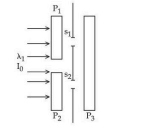
In a Young's double slit experiment, three polarizers are kept as shown in the figure. The transmission axes of P1P_1 and P2P_2 are orthogonal to each other. The polarizer P3P_3 covers both the slits with its transmission axis at 4545^\circ to those of P1P_1 and P2P_2. An unpolarized light of wavelength λ\lambda and intensity I0I_0 is incident on P1P_1 and P2P_2. The intensity at a point after P3P_3, where the path difference between the light waves from S1S_1 and S2S_2 is λ3\frac{\lambda}{3}, is:

Diagram of Young's double slit setup with two slits S1 and S2, polarizers P1 and P2 before the slits, and polarizer P3 covering both slits on the right.
  • A

    I0I_0

  • B

    I03\frac{I_0}{3}

  • C

    I02\frac{I_0}{2}

  • D

    I04\frac{I_0}{4}

Answer

Correct answer:C

Step-by-step solution

Standard Method

Given: Unpolarized light of intensity I0I_0 is incident on polarizers P1P_1 and P2P_2. Their transmission axes are mutually orthogonal. Polarizer P3P_3 has its transmission axis at 4545^\circ to both. The path difference between waves from S1S_1 and S2S_2 is λ3\frac{\lambda}{3}.

Find: The intensity after P3P_3.

When unpolarized light passes through a polarizer, its intensity becomes half. Therefore, after P1P_1 and P2P_2:

I1=I02,I2=I02I_1 = \frac{I_0}{2}, \qquad I_2 = \frac{I_0}{2}

Now each beam passes through P3P_3, whose axis is at 4545^\circ to the polarization directions of both beams. By Malus's law:

I1=I1cos245=I0212=I04I_1' = I_1 \cos^2 45^\circ = \frac{I_0}{2} \cdot \frac{1}{2} = \frac{I_0}{4} I2=I2cos245=I0212=I04I_2' = I_2 \cos^2 45^\circ = \frac{I_0}{2} \cdot \frac{1}{2} = \frac{I_0}{4}

Hence the total intensity after P3P_3 is:

I=I1+I2=I04+I04=I02I = I_1' + I_2' = \frac{I_0}{4} + \frac{I_0}{4} = \frac{I_0}{2}

The solution states the correct option is C. Therefore, the intensity is I02\frac{I_0}{2}, so the correct option is C.

Stepwise Use of Malus's Law

Given: Three polarizers are used in a Young's double slit arrangement. P1P_1 and P2P_2 are orthogonal, and P3P_3 is inclined at 4545^\circ to both. Incident light is unpolarized with intensity I0I_0.

Find: The intensity at the observation point after P3P_3.

For unpolarized incident light, the intensity after a polarizer is reduced to half:

I1=I02,I2=I02I_1 = \frac{I_0}{2}, \qquad I_2 = \frac{I_0}{2}

Since the transmission axis of P3P_3 makes an angle 4545^\circ with each of these polarized beams, each beam is again reduced by a factor of cos245\cos^2 45^\circ:

I3=I1cos245+I2cos245I_3 = I_1 \cos^2 45^\circ + I_2 \cos^2 45^\circ

Substitute cos245=12\cos^2 45^\circ = \frac{1}{2}:

I3=I0212+I0212I_3 = \frac{I_0}{2} \cdot \frac{1}{2} + \frac{I_0}{2} \cdot \frac{1}{2} I3=I04+I04=I02I_3 = \frac{I_0}{4} + \frac{I_0}{4} = \frac{I_0}{2}

Therefore, the final intensity is I02\frac{I_0}{2} and the correct option is C.

Common mistakes

  • Assuming that because P1P_1 and P2P_2 are orthogonal, one of the two beams has zero intensity. That is wrong because each slit receives unpolarized light independently and each beam first becomes I02\frac{I_0}{2} after its own polarizer. Apply Malus's law separately to each path.

  • Ignoring the effect of P3P_3 on both beams. This is incorrect because the light emerging from both slits must pass through P3P_3, and each beam is reduced by the factor cos245\cos^2 45^\circ. Always account for every polarizer in sequence.

  • Using the path difference λ3\frac{\lambda}{3} directly to change the intensity without following the given solution logic. In the extracted solution, the answer is obtained using polarization and Malus's law only. Follow the working shown in the solution when deriving the final answer.

Practice more Diffraction & Polarisation questions

Get unlimited AI-adaptive practice, mastery tracking, and an AI tutor that explains every step — free to start.

Related questions