NVAMediumJEE 2025Inverse & Adjoint of a Matrix

JEE Mathematics 2025 Question with Solution

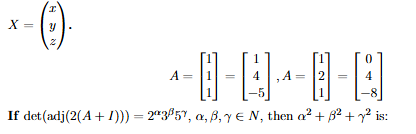
Let AA be a 3×33 \times 3 matrix such that XTAX=0X^TAX = 0 for all nonzero 3×13 \times 1 matrices

Image shows the vector $$X=\begin{pmatrix}x\\y\\z\end{pmatrix}$$ and the given relations $$A\begin{pmatrix}1\\1\\1\end{pmatrix}=\begin{pmatrix}1\\4\\-5\end{pmatrix}$$, $$A\begin{pmatrix}1\\2\\1\end{pmatrix}=\begin{pmatrix}0\\4\\-8\end{pmatrix}$$, followed by the determinant expression involving adjugate of $$2(A+I)$$ and asking for $$\alpha^2+\beta^2+\gamma^2$$.

Answer

Correct answer:44

Step-by-step solution

Standard Method

Given: XTAX=0X^TAX=0 for all nonzero vectors XX, and

A[111]=[145],A[121]=[048]A\begin{bmatrix}1\\1\\1\end{bmatrix}=\begin{bmatrix}1\\4\\-5\end{bmatrix},\qquad A\begin{bmatrix}1\\2\\1\end{bmatrix}=\begin{bmatrix}0\\4\\-8\end{bmatrix}

Also,

det(adj(2(A+I)))=2α3β5γ\det(\operatorname{adj}(2(A+I)))=2^{\alpha}3^{\beta}5^{\gamma}

Find: α2+β2+γ2\alpha^2+\beta^2+\gamma^2.

Since XTAX=0X^TAX=0 for all XX, the matrix AA must be skew-symmetric, so AT=AA^T=-A. Hence let

A=[0aba0cbc0]A=\begin{bmatrix} 0 & a & b\\ -a & 0 & c\\ -b & -c & 0 \end{bmatrix}

Using

A[111]=[a+ba+cbc]=[145]A\begin{bmatrix}1\\1\\1\end{bmatrix}=\begin{bmatrix}a+b\\-a+c\\-b-c\end{bmatrix}=\begin{bmatrix}1\\4\\-5\end{bmatrix}

and

A[121]=[2a+ba+2c2bc]=[048]A\begin{bmatrix}1\\2\\1\end{bmatrix}=\begin{bmatrix}2a+b\\-a+2c\\-2b-c\end{bmatrix}=\begin{bmatrix}0\\4\\-8\end{bmatrix}

we get the equations

a+b=1,a+c=4,bc=5a+b=1,\quad -a+c=4,\quad -b-c=-5 2a+b=0,a+2c=4,2bc=82a+b=0,\quad -a+2c=4,\quad -2b-c=-8

From a+b=1a+b=1 and 2a+b=02a+b=0,

a=1,b=2a=-1,\qquad b=2

Then from a+c=4-a+c=4,

c=3c=3

Therefore,

A=[012103230]A=\begin{bmatrix} 0 & -1 & 2\\ 1 & 0 & 3\\ -2 & -3 & 0 \end{bmatrix}

Now,

A+I=[112113231]A+I=\begin{bmatrix} 1 & -1 & 2\\ 1 & 1 & 3\\ -2 & -3 & 1 \end{bmatrix}

so

2(A+I)=[224226462]2(A+I)=\begin{bmatrix} 2 & -2 & 4\\ 2 & 2 & 6\\ -4 & -6 & 2 \end{bmatrix}

Its determinant is

det(2(A+I))=120\det(2(A+I))=120

For a 3×33\times 3 matrix MM,

det(adj(M))=(detM)31=(detM)2\det(\operatorname{adj}(M))=(\det M)^{3-1}=(\det M)^2

Hence,

det(adj(2(A+I)))=(120)2=14400\det(\operatorname{adj}(2(A+I)))=(120)^2=14400

Now factorize:

14400=26325214400=2^6\cdot 3^2\cdot 5^2

Therefore,

α=6,β=2,γ=2\alpha=6,\qquad \beta=2,\qquad \gamma=2

So,

α2+β2+γ2=62+22+22=36+4+4=44\alpha^2+\beta^2+\gamma^2=6^2+2^2+2^2=36+4+4=44

Therefore, the required value is 4444.

Determinant Property Focus

Given: det(adj(2(A+I)))=2α3β5γ\det(\operatorname{adj}(2(A+I)))=2^{\alpha}3^{\beta}5^{\gamma} after finding the matrix AA from the vector relations.

Find: α2+β2+γ2\alpha^2+\beta^2+\gamma^2.

The key determinant identity is

det(adj(M))=(detM)n1\det(\operatorname{adj}(M))=(\det M)^{n-1}

for an n×nn\times n matrix MM. Here n=3n=3, so once det(2(A+I))\det(2(A+I)) is known, the rest follows directly.

From the given vector equations and skew-symmetry, the solution obtains

A=[012103230]A=\begin{bmatrix} 0 & -1 & 2\\ 1 & 0 & 3\\ -2 & -3 & 0 \end{bmatrix}

Thus,

2(A+I)=[224226462]2(A+I)=\begin{bmatrix} 2 & -2 & 4\\ 2 & 2 & 6\\ -4 & -6 & 2 \end{bmatrix}

and

det(2(A+I))=120\det(2(A+I))=120

Now apply the adjugate determinant property:

det(adj(2(A+I)))=(120)2=14400=263252\det(\operatorname{adj}(2(A+I)))=(120)^2=14400=2^6\cdot 3^2\cdot 5^2

Hence,

α=6,β=2,γ=2\alpha=6,\quad \beta=2,\quad \gamma=2

Therefore,

α2+β2+γ2=36+4+4=44\alpha^2+\beta^2+\gamma^2=36+4+4=44

So the final answer is 4444.

Common mistakes

  • Assuming XTAX=0X^TAX=0 for all nonzero XX means AA is symmetric. This is wrong because the quadratic form vanishes for every XX only when the symmetric part is zero, which leads to AT=AA^T=-A. Start by taking AA as a skew-symmetric matrix.

  • Writing a general 3×33\times 3 matrix with nine unknowns instead of using skew-symmetry. This makes the system unnecessarily large and hides the structure. Use

    A=[0aba0cbc0]A=\begin{bmatrix}0&a&b\\-a&0&c\\-b&-c&0\end{bmatrix}

    so the diagonal entries are automatically zero.

  • Using the wrong determinant identity for the adjugate, such as det(adj(M))=det(M)\det(\operatorname{adj}(M))=\det(M). For an n×nn\times n matrix, the correct formula is det(adj(M))=(detM)n1\det(\operatorname{adj}(M))=(\det M)^{n-1}. Here n=3n=3, so the power must be 22.

Practice more Inverse & Adjoint of a Matrix questions

Get unlimited AI-adaptive practice, mastery tracking, and an AI tutor that explains every step — free to start.

Related questions