At steady state, the charge on the capacitor, as shown in the circuit below, is _____.
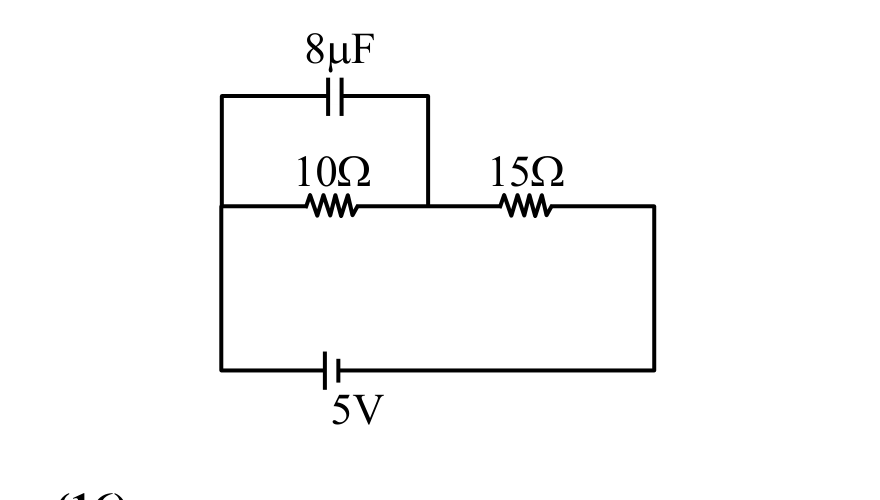
At steady state, the charge on the capacitor, as shown in the circuit below, is _____.

Correct answer:16
Standard Method
Given: A capacitor of is connected in parallel with the resistor. The resistors and are in series across a battery.
Find: Charge on the capacitor at steady state.
At steady state in a DC circuit, the capacitor behaves as an open circuit. Therefore, the voltage across the capacitor becomes equal to the voltage across the resistor.
The current through the resistive branch is
So, the potential difference across the resistor is
Hence the capacitor voltage is
Now use
Substituting,
Therefore, the charge on the capacitor is .
Using voltage division
Given: Series resistors and across , with an capacitor in parallel with the resistor.
Find: Final charge on the capacitor.
Since the capacitor is in parallel with the resistor, it must have the same steady-state voltage as that resistor.
Using voltage division,
Then,
Therefore, the required numerical value is 16.
The solution states the final answer correctly as , although part of its intermediate explanation generically assumes the capacitor voltage equals the battery voltage, which does not match this circuit. The correct circuit-based working gives the same final value.
Assuming the capacitor gets the full battery voltage . This is wrong because the capacitor is connected across only the resistor, not directly across the battery. First find the voltage across that resistor, then use .
Ignoring the steady-state behavior of the capacitor. In DC steady state, no current flows through the capacitor branch. Treat it as an open circuit first, then analyze only the resistive path to find the final capacitor voltage.
Using the total series resistance voltage drop incorrectly. The total is shared between and . Use current or voltage division to isolate the drop across .
Get unlimited AI-adaptive practice, mastery tracking, and an AI tutor that explains every step — free to start.