
When sec-butylcyclohexane reacts with bromine in the presence of sunlight, the major product is:
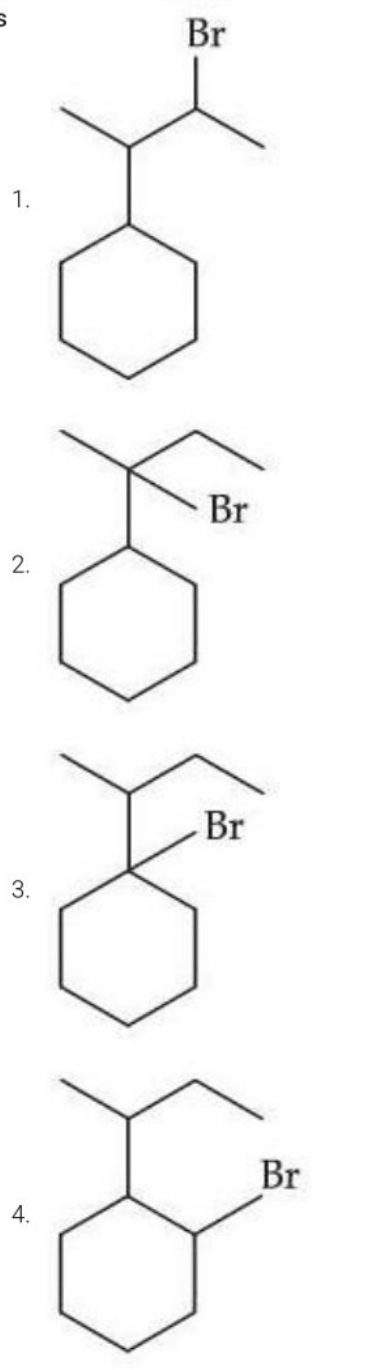
- A
Option 1
- B
Option 2
- C
Option 3
- D
Option 4
When sec-butylcyclohexane reacts with bromine in the presence of sunlight, the major product is:
Option 1
Option 2
Option 3
Option 4
Correct answer:B
Standard Method
Given: sec-butylcyclohexane reacts with bromine in the presence of sunlight.
Find: the major product of free radical bromination.
The reaction between sec-butylcyclohexane and bromine in the presence of sunlight is a free radical halogenation. Sunlight initiates radical formation, and bromination occurs preferentially at the position that gives the most stable free radical intermediate.
The relevant stability order is:
In sec-butylcyclohexane, abstraction of hydrogen from the tertiary carbon of the sec-butyl group forms the most stable radical intermediate. Therefore bromine substitutes at that tertiary carbon.
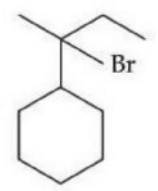
Thus, the structure shown as option 2 is the major product. Therefore, the correct option is B.
Radical Mechanism View
Given: reaction of sec-butylcyclohexane with bromine under sunlight.
Find: which product forms predominantly.
This reaction proceeds through a radical chain mechanism.
Hence the major product is the one with bromine attached at the tertiary carbon of the sec-butyl substituent, which corresponds to option 2. The correct option is B.
Choosing bromination at a secondary carbon of the side chain is incorrect because bromination is highly selective and favors formation of the more stable tertiary radical. Check radical stability before selecting the product.
Assuming substitution occurs randomly on the cyclohexane ring is incorrect because the major product is determined by the most stable radical intermediate, not by arbitrary hydrogen replacement.
Confusing free radical bromination with an ionic substitution mechanism is wrong because sunlight indicates a radical chain process. Use radical initiation and radical stability to predict the product.
Get unlimited AI-adaptive practice, mastery tracking, and an AI tutor that explains every step — free to start.