
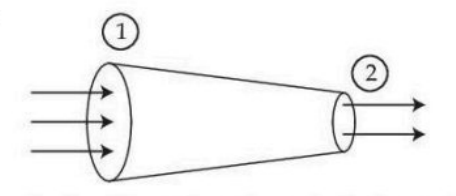
A tube of length is shown in the figure. The radius of cross section at point (1) is and at the point (2) is , respectively. If the velocity of water entering at point (1) is , then velocity of water leaving the point (2) will be:
- A
- B
- C
- D
A tube of length is shown in the figure. The radius of cross section at point (1) is and at the point (2) is , respectively. If the velocity of water entering at point (1) is , then velocity of water leaving the point (2) will be:
Correct answer:C
Standard Method
Given: Radius at point (1) is , radius at point (2) is , and entry velocity is .
Find: Velocity of water at point (2), .
For an incompressible fluid, the continuity equation applies:
The cross-sectional area is
So,
Simplifying,
Substituting , , and :
Thus, the velocity of water leaving point (2) is .
Therefore, the correct option is C.
Stepwise Continuity Equation
Given: The tube carries an incompressible fluid. The radii are and , with .
Find: The exit velocity .
Step 1: Use the principle of continuity.
where is cross-sectional area and is fluid speed.
Step 2: Express area in terms of radius.
Hence,
Cancelling ,
Step 3: Substitute the given values.
Step 4: Final result.
Therefore, the speed of water leaving point (2) is , so the correct option is C.
Using radius directly instead of area in the continuity equation is incorrect because the equation relates area × velocity, not radius × velocity. First convert cross section to , then apply .
Assuming the velocity remains unchanged is wrong because the tube narrows from point (1) to point (2). For an incompressible fluid, smaller cross-sectional area means larger speed. Compare the areas before concluding the change in velocity.
Forgetting to square the radii gives an incorrect area ratio. Since and , the area ratio is , not . Always use while finding area.
Get unlimited AI-adaptive practice, mastery tracking, and an AI tutor that explains every step — free to start.