MCQMediumJEE 2025Kinetic Energy & Work-Energy Theorem

JEE Physics 2025 Question with Solution

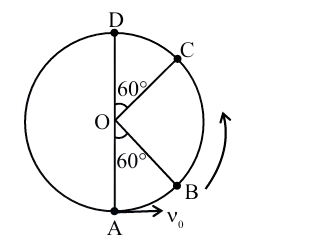
A bob of mass mm is suspended at a point OO by a light string of length ll and left to perform vertical motion (circular) as shown in the figure. Initially, by applying horizontal velocity v0v_0 at the point ‘A’, the string becomes slack when the bob reaches at the point ‘D’. The ratio of the kinetic energy of the bob at the points B and C is:

A vertical circle with center O, lowest point A, top point D, point B on the right lower side, point C on the right upper side, string length l, initial horizontal velocity v0 at A, and central angles marked 60° and 53°.
  • A

    22

  • B

    11

  • C

    44

  • D

    33

Answer

Correct answer:A

Step-by-step solution

Standard Method

Given: A bob of mass mm moves in a vertical circle of radius ll. The initial speed at point AA satisfies v02=5glv_0^2 = 5g l, and the string becomes slack at point DD, so vD2=glv_D^2 = g l.

Find: The ratio KEBKEC\frac{KE_B}{KE_C}.

Using conservation of mechanical energy between points AA and BB,

12mv02=12mvB2+mgl2\frac{1}{2} m v_0^2 = \frac{1}{2} m v_B^2 + mg\frac{l}{2}

Substituting v02=5glv_0^2 = 5 g l,

12m(5gl)=12mvB2+mgl2\frac{1}{2} m(5 g l) = \frac{1}{2} m v_B^2 + mg\frac{l}{2}

Hence,

KEB=12mvB2=2mglKE_B = \frac{1}{2} m v_B^2 = 2mgl

At point CC, using energy relation with point DD,

12mvC2=12mvD2+mgl2\frac{1}{2} m v_C^2 = \frac{1}{2} m v_D^2 + mg\frac{l}{2}

Using vD2=glv_D^2 = g l,

12mvC2=12mgl+mgl2\frac{1}{2} m v_C^2 = \frac{1}{2} m g l + mg\frac{l}{2}

Therefore,

KEC=mglKE_C = mgl

Now,

KEBKEC=2mglmgl=2\frac{KE_B}{KE_C} = \frac{2mgl}{mgl} = 2

Therefore, the ratio of kinetic energies at BB and CC is 2:12:1, so the correct option is A.

Stepwise Energy Comparison

Given: The bob executes vertical circular motion with points A,B,C,DA, B, C, D as shown. The initial condition gives v02=5glv_0^2 = 5g l. At the top point DD, the string just becomes slack, so vD2=glv_D^2 = g l.

Find: The ratio of kinetic energies at BB and CC.

Step 1: Apply energy conservation from AA to BB:

12mv02=12mvB2+mghB\frac{1}{2} m v_0^2 = \frac{1}{2} m v_B^2 + mgh_B

With hB=l2h_B = \frac{l}{2},

12m(5gl)=12mvB2+mgl2\frac{1}{2} m (5 g l) = \frac{1}{2} m v_B^2 + m g \frac{l}{2}

So,

12mvB2=2mgl\frac{1}{2} m v_B^2 = 2mgl

Thus,

KEB=2mglKE_B = 2mgl

Step 2: Apply energy conservation from CC to DD:

12mvC2=12mvD2+mghC\frac{1}{2} m v_C^2 = \frac{1}{2} m v_D^2 + mgh_C

With vD2=glv_D^2 = g l and hC=l2h_C = \frac{l}{2},

12mvC2=12mgl+mgl2\frac{1}{2} m v_C^2 = \frac{1}{2} m g l + m g \frac{l}{2}

Hence,

KEC=mglKE_C = mgl

Step 3: Take the ratio:

KEBKEC=2mglmgl=2\frac{KE_B}{KE_C} = \frac{2mgl}{mgl} = 2

Therefore, the required ratio is 22.

Common mistakes

  • Using the same reference level incorrectly for gravitational potential energy. This gives wrong heights for points BB and CC. Take the lowest point AA as reference and use the vertical rise shown in the figure.

  • Forgetting the slack-string condition at point DD. When the string just becomes slack at the top, the correct condition is vD2=glv_D^2 = g l, not vD=0v_D = 0. Use this to evaluate the kinetic energy at CC.

  • Comparing speeds instead of kinetic energies. Since kinetic energy is 12mv2\frac{1}{2}mv^2, the ratio must be taken using squared speeds or directly through energy expressions, not by using vB:vCv_B:v_C.

Practice more Kinetic Energy & Work-Energy Theorem questions

Get unlimited AI-adaptive practice, mastery tracking, and an AI tutor that explains every step — free to start.

Related questions