
Appearance of blood red colour on treatment of the sodium fusion extract of an organic compound with in presence of concentrated indicates the presence of element(s):
- A
- B
- C
- D
Appearance of blood red colour on treatment of the sodium fusion extract of an organic compound with in presence of concentrated indicates the presence of element(s):
Correct answer:C
Standard Method
Given: The sodium fusion extract of an organic compound is treated with in presence of concentrated , and a blood red colour appears.
Find: Which element(s) are present in the compound.
In Lassaigne's test, when an organic compound contains both nitrogen and sulphur, sodium fusion can produce thiocyanate species. This thiocyanate then reacts with ferric ions to give a blood red coloured complex.
The solution explains that nitrogen alone gives Prussian blue colour, but blood red colour appears when sulphur is present along with nitrogen because ferric thiocyanate is formed.
Therefore, the appearance of blood red colour confirms the presence of .
The correct option is C.
Reaction-Based Explanation
Given: Blood red colour is observed after treating the sodium fusion extract with and concentrated .
Find: The elements responsible for this observation.
The extracted working states that sodium fusion converts the relevant elements into ionic forms. For nitrogen-containing compounds, sodium cyanide is formed. In the presence of both nitrogen and sulphur, thiocyanate formation leads to the characteristic blood red test.
The solution also notes the following intermediate chemistry:
However, the key conclusion given is that a blood red colour is due to ferric thiocyanate, which requires both nitrogen and sulphur.
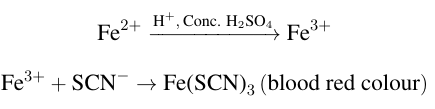
Hence, the compound contains .
The correct option is C. The solution stating option A conflicts with the detailed working and final stated answer, so the working is taken as authoritative.
Assuming that blood red colour indicates nitrogen alone. That is incorrect because nitrogen alone gives the Prussian blue test, not the blood red ferric thiocyanate test. Check whether sulphur is also present.
Confusing the halogen test with this observation. Bromine is not identified by the blood red colour in this Lassaigne-based reaction. Focus on thiocyanate formation with ferric ions instead.
Remembering only the reagent and ignoring the role of concentrated in generating the conditions for ferric ion formation. The final coloured species is associated with ferric thiocyanate.
Get unlimited AI-adaptive practice, mastery tracking, and an AI tutor that explains every step — free to start.