
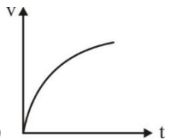
A small steel ball is dropped into a long cylinder containing glycerine. Which one of the following is the correct representation of the velocity-time graph for the transit of the ball?
- A
Linear
- B
Exponential
- C
Parabolic
- D
Constant
A small steel ball is dropped into a long cylinder containing glycerine. Which one of the following is the correct representation of the velocity-time graph for the transit of the ball?
Linear
Exponential
Parabolic
Constant
Correct answer:B
Standard Method
Given: A small steel ball falls through glycerine, a viscous liquid.
Find: The correct nature of the velocity-time graph during its motion.
As the ball is dropped, it starts accelerating downward due to gravity. While moving through glycerine, it experiences:
Initially, the speed increases, so the drag force also increases. After some time, the net force becomes zero and the ball attains terminal velocity . Hence the graph rises at first and then gradually levels off to a constant value.
Therefore, the velocity approaches terminal velocity exponentially, so the correct option is B.
Equation-Based Derivation
Given: The ball moves through glycerine under gravity, buoyancy, and viscous drag.
Find: The form of as a function of .
The forces acting on the ball are described by
where
Rearranging the force equation gives
Using constants
the differential equation becomes
Integrating,
which yields
Thus increases with time exponentially and approaches a constant terminal value. Therefore, the correct option is B (Exponential).
Assuming the velocity remains constant from the moment the ball is released. This is wrong because the ball initially accelerates before viscous drag builds up. The speed becomes constant only after terminal velocity is reached.
Assuming the graph is linear because gravity acts downward. This ignores that viscous drag increases with velocity, reducing the acceleration continuously. The slope therefore decreases with time.
Ignoring the buoyant force and considering only gravity and drag. This is incorrect because buoyancy also acts upward and affects the final terminal velocity. Include all forces when reasoning about the motion.
Get unlimited AI-adaptive practice, mastery tracking, and an AI tutor that explains every step — free to start.