
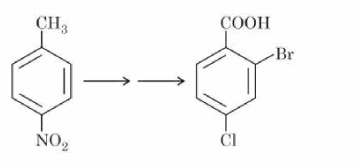
In the above conversion the correct sequence of reagents to be added is
- A
(i) , (ii) , (iii) , (iv)
- B
(i) , (ii) , (iii) , (iv)
- C
(i) , (ii) , (iii) , (iv) , (v)
- D
(i) , (ii) , (iii) , (iv) , (v)
In the above conversion the correct sequence of reagents to be added is
(i) , (ii) , (iii) , (iv)
(i) , (ii) , (iii) , (iv)
(i) , (ii) , (iii) , (iv) , (v)
(i) , (ii) , (iii) , (iv) , (v)
Correct answer:C
Standard Method
Given: A nitro-substituted toluene derivative is converted into an aromatic compound containing , , and .
Find: The correct sequence of reagents.
The sequence must include bromination of the ring, reduction of the nitro group, diazotisation followed by Sandmeyer reaction, and oxidation of the methyl group.
First, bromination is carried out using
which introduces on the aromatic ring.
Next, the nitro group is reduced to an amino group using
so that diazotisation becomes possible.
Then the aromatic amine is diazotised using
forming the diazonium salt, which is converted to the chloro derivative by Sandmeyer reaction with
Finally, the methyl group is oxidised to the carboxylic acid using
Therefore, the correct order is:
The correct option is C.
Functional Group Tracking
Given: The initial compound contains and , while the final compound contains , , and .
Find: Which option matches these conversions in order.
Track the required functional group changes directly:
followed by
Only option C contains all these essential transformations in the correct sequence. Hence, the correct option is C.
Applying too early is incorrect because oxidation of the methyl group before completing substitution steps can change the directing effects on the aromatic ring. Perform the substitution sequence first, then oxidise to .
Trying to replace directly by is wrong because the nitro group does not undergo Sandmeyer substitution. First reduce to , then diazotise, and then use .
Using directly instead of diazotisation followed by Sandmeyer reaction is incorrect here because the required chlorine substitution comes from replacement of the diazonium group, not simple electrophilic chlorination.
Get unlimited AI-adaptive practice, mastery tracking, and an AI tutor that explains every step — free to start.