MCQEasyJEE 2023Potentiometer

JEE Physics 2023 Question with Solution

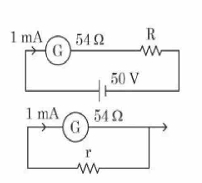
For designing a voltmeter of range 50V50\,V and an ammeter of range 10mA10\,mA using a galvanometer which has a coil resistance 54Ω54\,\Omega and shows full-scale deflection for 1mA1\,mA as shown in the figure, choose the correct statements.

% Statements (A) For voltmeter R50kΩR \approx 50\,k\Omega

(B) For ammeter r0.2Ωr \approx 0.2\,\Omega

(C) For ammeter r=6Ωr = 6\,\Omega

(D) For voltmeter R=5kΩR = 5\,k\Omega

(E) For voltmeter R=500ΩR = 500\,\Omega

Two galvanometer conversion circuits are shown: upper circuit has galvanometer of 54 ohm with series resistance R for 50 V voltmeter, lower circuit has same galvanometer with parallel shunt r for ammeter conversion, and 1 mA full-scale current is marked.
  • A

    (A) and (C)

  • B

    (A) and (B)

  • C

    (C) and (D)

  • D

    (B) and (E)

Answer

Correct answer:A

Step-by-step solution

Standard Method

Given: Full scale deflection current of galvanometer is Ig=1mA=103AI_g = 1\,mA = 10^{-3}\,A and galvanometer resistance is G=54ΩG = 54\,\Omega.

Find: Which statements are correct for designing a voltmeter of range 50V50\,V and an ammeter of range 10mA10\,mA.

For a voltmeter, a high resistance RR is connected in series with the galvanometer.

V=Ig(G+R)V = I_g(G + R)

Substituting the given values,

50=103(54+R)50 = 10^{-3}(54 + R) 54+R=50×10354 + R = 50 \times 10^{3} R49946Ω50kΩR \approx 49946\,\Omega \approx 50\,k\Omega

Thus, statement (A) is correct.

For an ammeter, a shunt resistance rr is connected in parallel with the galvanometer. Total current is I=10mAI = 10\,mA and galvanometer current is Ig=1mAI_g = 1\,mA. So, current through shunt is

Is=IIg=9mAI_s = I - I_g = 9\,mA

Using the shunt formula,

r=IgIsG=19×54=6Ωr = \frac{I_g}{I_s} \, G = \frac{1}{9} \times 54 = 6\,\Omega

Thus, statement (C) is correct.

Therefore, the correct statements are (A) and (C). The correct option is A.

Quick Tip

Given: The galvanometer has Ig=1mAI_g = 1\,mA and G=54ΩG = 54\,\Omega.

Find: The correct pair of statements.

A galvanometer is converted into a voltmeter by adding a large resistance in series, so the series resistance must be close to

VIg=50103=50kΩ\frac{V}{I_g} = \frac{50}{10^{-3}} = 50\,k\Omega

Since 54Ω54\,\Omega is very small compared to this value, the required series resistance is approximately 50kΩ50\,k\Omega. So statement (A) is valid.

For ammeter conversion, the shunt must carry the remaining current. Here, the shunt carries 9mA9\,mA while the galvanometer carries 1mA1\,mA, so the shunt resistance must be smaller than 54Ω54\,\Omega by a factor of 99:

r=549=6Ωr = \frac{54}{9} = 6\,\Omega

So statement (C) is valid.

Therefore, the correct option is A.

Common mistakes

  • Using series resistance formula for the ammeter case is incorrect because an ammeter requires a shunt resistance in parallel, not a resistor in series. For ammeter design, divide the current between galvanometer and shunt and use the shunt relation.

  • Taking the shunt current as 10mA10\,mA instead of 9mA9\,mA is wrong because the galvanometer itself already carries 1mA1\,mA at full-scale deflection. First subtract galvanometer current from total current.

  • Ignoring the galvanometer resistance 54Ω54\,\Omega while writing the exact voltmeter equation can lead to a wrong setup. Use V=Ig(G+R)V = I_g(G+R) and then approximate only at the final stage.

Practice more Potentiometer questions

Get unlimited AI-adaptive practice, mastery tracking, and an AI tutor that explains every step — free to start.

Related questions