
Match List I with List II
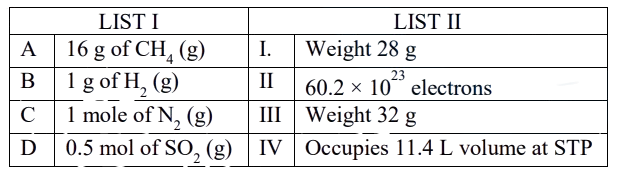
Choose the correct answer from the options given below:
- A
A-II, B-IV, C-I, D-III
- B
A-II, B-IV, C-III, D-I
- C
A-II, B-III, C-IV, D-I
- D
A-I, B-III, C-II, D-IV
Match List I with List II
Choose the correct answer from the options given below:
A-II, B-IV, C-I, D-III
A-II, B-IV, C-III, D-I
A-II, B-III, C-IV, D-I
A-I, B-III, C-II, D-IV
Correct answer:C
Standard Method
Given: Match List I with List II.
Find: The correct matching option.
For A, mole of . One molecule of has electrons, so mole contains
electrons. Hence A-II.
For B, mole of . At STP, mole occupies , so mole occupies
which corresponds to approximately . Hence B-IV.
For C, mole of . Hence C-I.
For D, mole of has mass
Hence D-III.
So the full matching is A-II, B-IV, C-I, D-III.
The solution concludes "The Correct Option is C", but the extracted working gives A-II, B-IV, C-I, D-III, which matches option A. Therefore, there is a discrepancy between the displayed option label and the working.
Detailed Matching Check
Given:
Find: The correct item in List II for each entry.
So this is mole of . Each molecule has electrons. Thus total electrons in mole are
So A-II.
At STP,
Therefore,
So B-IV.
So C-I.
Hence mass is
So D-III.
Therefore, the matching is A-II, B-IV, C-I, D-III.
Confusing molar mass with mass of the given sample. For mol of , using directly is wrong because is for mole. Multiply by to get .
Using the wrong molar volume at STP. For mole of , the volume is not because that is for mole. Take half of it to get about .
Counting electrons in incorrectly. One molecule has electrons from carbon and from four hydrogens, so total electrons per molecule. Then multiply by Avogadro's number for one mole.
Get unlimited AI-adaptive practice, mastery tracking, and an AI tutor that explains every step - free to start.