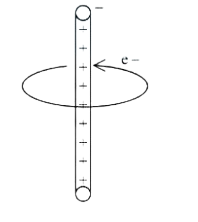
An electron revolves around an infinite cylindrical wire having uniform linear charge density 2×10⁻⁸C/m−1 in a circular path under the influence of an attractive electrostatic field as shown in the figure. The velocity of the electron with which it is revolving is _____ ×106m/s−1. Given mass of the electron =9×10⁻³¹kg
Answer
Correct answer:8
Step-by-step solution
Standard Method
Given: Linear charge density λ=2×10⁻⁸C/m, mass of electron m=9×10⁻³¹kg, charge of electron e=1.6×10⁻¹⁹C.
Find: The value of velocity in the form v=(__)×106m/s.
For an infinite line charge, the electric field at distance r is
E=2πϵ0rλ
The electrostatic force on the electron is
F=eE=2πϵ0reλ
This force provides the centripetal force for circular motion:
Given: The electron moves in a circular path around an infinite line charge.
Find: Why the speed can be found without knowing the radius.
The electric field of an infinite line charge varies as 1/r, so the electrostatic force on the electron also varies as 1/r.
The centripetal force requirement is
rmv2
which also contains the same 1/r dependence after equating forces. Hence the radius cancels immediately:
rmv2=2πϵ0reλv2=2πϵ0meλ
So the speed depends only on e, λ, ϵ0 and m, not on the orbit radius. Substituting values gives v≈8×10⁶m/s. Therefore, the required numerical value is 8.
Common mistakes
Using the electric field formula of a point charge instead of that of an infinite line charge is incorrect because the symmetry is cylindrical, not spherical. Use E=2πϵ0rλ for an infinite wire.
Keeping the electron charge as negative while computing the magnitude of force can create sign confusion. For centripetal force, equate magnitudes and use the negative sign only to indicate that the force is attractive toward the wire.
Forgetting that r cancels on both sides leads to unnecessary dependence on orbit radius. Since both electrostatic force and centripetal requirement contain 1/r, the speed is independent of r here.
Practice more Electric Field & Field Lines questions
Get unlimited AI-adaptive practice, mastery tracking, and an AI tutor that explains every step — free to start.