MCQMediumJEE 2023Determinants Basics

JEE Mathematics 2023 Question with Solution

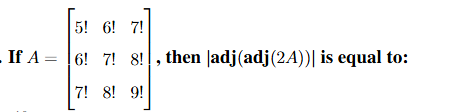
A matrix question showing A as a 3 by 3 matrix with entries 5!, 6!, 7! in first row, 6!, 7!, 8! in second row, and 7!, 8!, 9! in third row, asking the value of determinant of adj(adj(2A)).
  • A

    2162^{16}

  • B

    282^8

  • C

    2122^{12}

  • D

    2202^{20}

Answer

Correct answer:A

Step-by-step solution

Standard Method

Given: The matrix AA is the 3×33 \times 3 matrix shown in the figure.

Find: adj(adj(2A))|\operatorname{adj}(\operatorname{adj}(2A))|.

From the solution, the determinant of AA is evaluated by factoring factorial terms and reducing the determinant:

A=15!6!7!164217561872|A| = \frac{1}{5!6!7!} \begin{vmatrix} 1 & 6 & 42 \\ 1 & 7 & 56 \\ 1 & 8 & 72 \end{vmatrix}

Apply the row transformations shown:

R3R3R2,R2R2R1R_3 \to R_3 - R_2, \qquad R_2 \to R_2 - R_1

which gives

184201140116\begin{vmatrix} 1 & 8 & 42 \\ 0 & 1 & 14 \\ 0 & 1 & 16 \end{vmatrix}

Hence, as stated in the solution,

A=2|A| = 2

Now use the determinant property of adjugate for an n×nn \times n matrix:

adj(B)=Bn1|\operatorname{adj}(B)| = |B|^{n-1}

For B=2AB = 2A and n=3n = 3,

2A=23A=232=24|2A| = 2^3 |A| = 2^3 \cdot 2 = 2^4

Therefore,

adj(2A)=2A2=(24)2=28|\operatorname{adj}(2A)| = |2A|^{2} = (2^4)^2 = 2^8

Again applying the same property to adj(2A)\operatorname{adj}(2A),

adj(adj(2A))=adj(2A)2=(28)2=216|\operatorname{adj}(\operatorname{adj}(2A))| = |\operatorname{adj}(2A)|^{2} = (2^8)^2 = 2^{16}

Therefore, the correct option is A.

Note: The solution heading says B, but the working clearly concludes 2162^{16}, which matches option A.

Common mistakes

  • Using adj(B)=B|\operatorname{adj}(B)| = |B| is incorrect. For an n×nn \times n matrix, the correct relation is adj(B)=Bn1|\operatorname{adj}(B)| = |B|^{n-1}. Here n=3n = 3, so the exponent must be 22.

  • Forgetting that 2A2A|2A| \neq 2|A| for a 3×33 \times 3 matrix is a common error. The correct rule is kA=knA|kA| = k^n |A|, so 2A=23A|2A| = 2^3 |A|.

  • Stopping after finding adj(2A)|\operatorname{adj}(2A)| gives only the intermediate result. The question asks for adj(adj(2A))|\operatorname{adj}(\operatorname{adj}(2A))|, so the adjugate determinant property must be applied one more time.

Practice more Determinants Basics questions

Get unlimited AI-adaptive practice, mastery tracking, and an AI tutor that explains every step - free to start.
Related questions