
If the degree of dissociation of an aqueous solution of weak monobasic acid is determined to be , then the observed freezing point will be % higher than the expected/theoretical freezing point. (Nearest integer)
NVAEasyJEE 2023Colligative Properties
JEE Chemistry 2023 Question with Solution
Answer
Correct answer:30
Step-by-step solution
Standard Method
Given: Degree of dissociation of weak monobasic acid is .
Find: The percentage by which the observed freezing point effect differs from the expected/theoretical value.
For a weak monobasic acid:
Substituting ,
The observed depression in freezing point is:
The theoretical value without dissociation is:
Hence,
Therefore, the required nearest integer is 30.
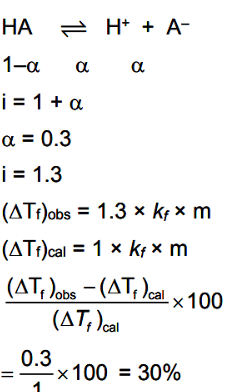
Using van’t Hoff factor
Given: Weak monobasic acid in aqueous solution with degree of dissociation .
Find: Percentage increase in observed freezing point depression over the theoretical value for no dissociation.
A weak monobasic acid dissociates as:
If the initial number of particles is taken as , then after dissociation the total number of particles becomes:
So the van't Hoff factor is:
Now freezing point depression is proportional to :
Thus,
and
Therefore, the percentage higher value is:
Therefore, the answer is 30.
Common mistakes
Using for complete dissociation is wrong because the acid is weak and only dissociates to the extent . Use instead.
Confusing freezing point with depression in freezing point is incorrect. The calculation is based on freezing point depression , whose relative increase is asked here.
Taking the percentage directly as is wrong because means a fraction, not a percent. Convert it using multiplication by to get .
Practice more Colligative Properties questions
Get unlimited AI-adaptive practice, mastery tracking, and an AI tutor that explains every step — free to start.
Related questions
- Elements P and Q form two types of non-volatile, non-ionizable compounds PQ and PQ₂. When 1 g of PQ is…Medium · JEE 2026
- The osmotic pressure of a living cell is 12 atm at 300 K. The strength of sodium chloride solution that is…Easy · JEE 2026
- A substance 'X' (1.5 g) dissolved in 150 g of a solvent 'Y' (molar mass = 300 g mol^-1) led to an elevation…Medium · JEE 2026
- W g of a non-volatile electrolyte solid solute of molar mass M g mol^-1 when dissolved in 100 mL water…Medium · JEE 2026
- A solution is prepared by dissolving 0.3 g of a non-volatile non-electrolyte solute A of molar mass 60 g…Easy · JEE 2026
- Consider the following aqueous solutions. I. 2.2 g Glucose in 125 mL of solution. II. 1.9 g Calcium chloride…Medium · JEE 2026