
Two vertical parallel mirrors A and B are separated by . A point object O is placed at a distance of from mirror A. The distance of the second nearest image behind mirror A from the mirror A is:
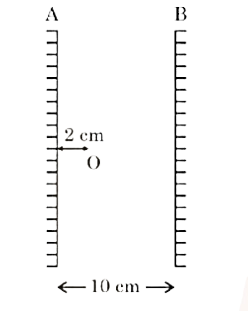
Two vertical parallel mirrors A and B are separated by . A point object O is placed at a distance of from mirror A. The distance of the second nearest image behind mirror A from the mirror A is:
Correct answer:18
Standard Method
Given: Two vertical parallel mirrors A and B are separated by . The object O is at a distance of from mirror A.
Find: The distance of the second nearest image behind mirror A from mirror A.
For multiple reflections between two plane mirrors, images are formed alternately behind the two mirrors.
The first image behind mirror A is formed at the same distance as the object is in front of it:
The object is in front of mirror B, so the first image behind mirror B is at
behind B.
This image behind B acts as an object for mirror A. Its distance from mirror A is
So, the second nearest image behind mirror A is at from mirror A.
Therefore, the required answer is .
Image Sequence Tracking
Given: Mirror separation is and the object is from mirror A.
Find: The second nearest image behind mirror A.
Track the images in order near mirror A:
This becomes the next image behind A in the sequence of multiple reflections.
Hence, the nearest image behind A is at and the second nearest image behind A is at .
Therefore, the answer is .
Treating the distance of the object from mirror B as by adding is incorrect. The object lies between the mirrors, so its distance from B is . Always measure distance from the mirror to the actual object position.
Confusing the first image behind mirror A with the second nearest image behind A leads to the answer . The question asks specifically for the second nearest image, so the multiple-reflection sequence must be continued.
Using spherical mirror formulas is wrong because the setup consists of parallel plane mirrors. Here, image distance equals object distance for each reflection, and positions must be tracked geometrically.
Get unlimited AI-adaptive practice, mastery tracking, and an AI tutor that explains every step — free to start.