MCQMediumJEE 2023Ethers

JEE Chemistry 2023 Question with Solution

In the following reaction, ‘B’ is
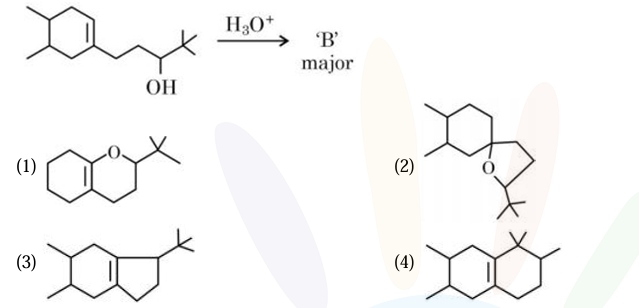
Reaction scheme of an unsaturated alcohol treated with hydronium ion to form major product B, with four product options shown below.
  • A

    Option (1)

  • B

    Option (2)

  • C

    Option (3)

  • D

    Option (4)

Answer

Correct answer:D

Step-by-step solution

Standard Method

Given: An unsaturated alcohol undergoes reaction with H3O+\text{H}_3\text{O}^+ to form major product B.

Find: The correct product formed in the acid-catalyzed cyclization.

The reaction proceeds through acid-catalyzed intramolecular cyclization of the alcohol.

  1. Protonation of the alcohol: The OH-\text{OH} group is protonated by H3O+\text{H}_3\text{O}^+, converting it into a better leaving group.
  2. Carbocation formation: Water leaves and a carbocation is generated.
  3. Cyclization: The double bond attacks intramolecularly, leading to ring closure. The preferred pathway is the one that forms the more stable tertiary carbocation and gives a six-membered ring arrangement.
  4. Rearrangement and deprotonation: After the favorable carbocation forms, loss of a proton gives the final cyclic product.
Stepwise acid-catalyzed cyclization mechanism showing protonation, carbocation formation, methyl shift, ring closure, and final fused cyclic product.

From the mechanism shown, the major product corresponds to option (4).

Therefore, the correct option is D.

Why option (4) is favored

Given: The substrate contains both an alcohol group and a double bond, so intramolecular attack is possible under acidic conditions.

Find: Why the major product is option (4) and not the others.

Under acidic conditions, the reaction does not stop at a simple substitution step. Instead, it proceeds through a carbocation intermediate. Such reactions are governed mainly by:

  • carbocation stability, and
  • favorable ring formation.

The intramolecular attack occurs in a way that produces the more stable tertiary carbocation. The pathway shown in the mechanism also includes a methyl shift, which further stabilizes the intermediate before the final product is formed.

Because of this stabilization sequence, the product corresponding to option (4) is favored over the structures in options (1), (2), and (3).

Hence, the major product B is option (4), that is, D.

Common mistakes

  • Assuming the reaction gives direct dehydration only is incorrect because the solution shows intramolecular cyclization through a carbocation. Always check whether a nearby double bond can attack and form a ring.

  • Choosing a product without considering carbocation stability is a common error. The major product is determined by formation of the more stable tertiary carbocation, not by the first structure that appears possible.

  • Ignoring possible rearrangement such as methyl shift leads to the wrong product. In acid-catalyzed carbocation reactions, rearrangements must be examined before fixing the final structure.

Practice more Ethers questions

Get unlimited AI-adaptive practice, mastery tracking, and an AI tutor that explains every step — free to start.

Related questions