MCQEasyJEE 2023Simple Harmonic Motion (SHM)

JEE Physics 2023 Question with Solution

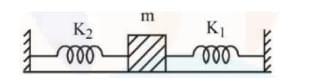
A mass mm is attached to two springs of spring constants K1K_1 and K2K_2, respectively, as shown. The time period of oscillation of the mass mm on a frictionless surface is:

A block labeled m is placed on a horizontal frictionless surface between two fixed walls, connected to the left wall by spring K2 and to the right wall by spring K1.
  • A

    (12π)mK1K2\left(\frac{1}{2\pi}\right)\sqrt{\frac{m}{K_1-K_2}}

  • B

    (12π)K1+K2m\left(\frac{1}{2\pi}\right)\sqrt{\frac{K_1+K_2}{m}}

  • C

    2πmK1+K22\pi\sqrt{\frac{m}{K_1+K_2}}

  • D

    2πK1K2m2\pi\sqrt{\frac{K_1-K_2}{m}}

Answer

Correct answer:C

Step-by-step solution

Standard Method

Given: A mass mm is attached to two springs with spring constants K1K_1 and K2K_2 on a frictionless surface.

Find: The time period of oscillation.

Both the springs are in parallel.

For springs in parallel, the equivalent spring constant is

Keq=K1+K2K_{eq} = K_1 + K_2

The time period of a mass-spring system is

T=2πmKeqT = 2\pi \sqrt{\frac{m}{K_{eq}}}

Substituting Keq=K1+K2K_{eq} = K_1 + K_2,

T=2πmK1+K2T = 2\pi \sqrt{\frac{m}{K_1 + K_2}}

Therefore, the time period is 2πmK1+K22\pi \sqrt{\frac{m}{K_1+K_2}} and the correct option is C.

Equivalent Spring Constant Approach

Given: The two springs are connected to the same mass, so they experience the same displacement during oscillation.

Find: The expression for the time period TT.

When the mass is displaced by some distance, both springs contribute restoring force. Therefore their effective stiffness adds.

So, for springs in parallel,

Keq=K1+K2K_{eq} = K_1 + K_2

For simple harmonic motion of a mass-spring system,

T=2πmKT = 2\pi \sqrt{\frac{m}{K}}

Using the equivalent spring constant,

T=2πmKeq=2πmK1+K2T = 2\pi \sqrt{\frac{m}{K_{eq}}} = 2\pi \sqrt{\frac{m}{K_1 + K_2}}

Hence, the required time period is 2πmK1+K22\pi \sqrt{\frac{m}{K_1+K_2}}.

Common mistakes

  • Treating the springs as if they were in series. That is wrong because the mass is connected so that both springs undergo the same displacement. Use parallel combination, so the effective spring constant is K1+K2K_1 + K_2.

  • Using the wrong SHM formula, such as writing frequency instead of time period. For a mass-spring system, the time period is T=2πmKT = 2\pi\sqrt{\frac{m}{K}}, not its reciprocal.

  • Choosing an option with K1K2K_1-K_2. Effective stiffness cannot be obtained by subtracting spring constants in this arrangement. Both springs increase the restoring force, so their constants add.

Practice more Simple Harmonic Motion (SHM) questions

Get unlimited AI-adaptive practice, mastery tracking, and an AI tutor that explains every step — free to start.

Related questions