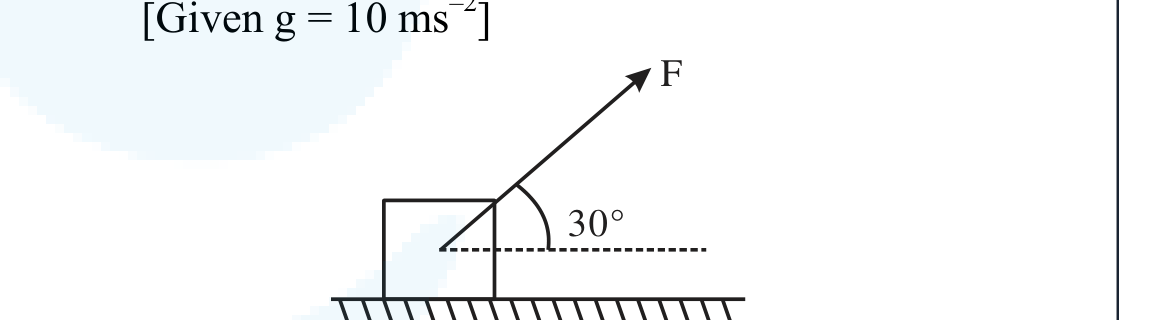
As shown in the figure, a block of mass lying on a horizontal surface is pulled by a force acting at an angle with horizontal. For , the block will just start to move for the value of : [Given ]
- A
- B
- C
- D
As shown in the figure, a block of mass lying on a horizontal surface is pulled by a force acting at an angle with horizontal. For , the block will just start to move for the value of : [Given ]

Correct answer:D
Standard Method
Given: Mass of block is , coefficient of static friction is , angle of pull is , and .
Find: The value of for which the block just starts to move.
Resolve the applied force into horizontal and vertical components:
The upward vertical component reduces the normal reaction. Therefore,
Substituting the given values,
At the point of impending motion, the horizontal component of the pull equals the maximum static friction:
So,
Multiplying by ,
Therefore, the required force is approximately . The numerical working matches option B, although the solution incorrectly labels it as D.
Force Balance Explanation
Given: The block is on a horizontal rough surface and is pulled upward at .
Find: The pull needed to produce impending motion.
The key idea is that friction depends on the normal reaction, and the normal reaction is not equal to here because the applied force has an upward component.
Hence,
Combining these,
Using and ,
This gives the same result,
So the correct choice from the given options is B.
Using directly is wrong because the applied force has an upward component that reduces the normal reaction. First write .
Equating the whole applied force to friction is incorrect. Only the horizontal component opposes friction along the surface, so use .
Using kinetic friction instead of limiting static friction is a conceptual error. Since the block is about to move, the correct condition is impending motion, so friction is .
Get unlimited AI-adaptive practice, mastery tracking, and an AI tutor that explains every step — free to start.