NVAMediumJEE 2023Colligative Properties

JEE Chemistry 2023 Question with Solution

25 mL of an aqueous solution of KCl was found to require 20 mL of 1 M AgNO3{}_3 solution when titrated using K2{}_2CrO4{}_4 as an indicator. What is the depression in freezing point of KCl solution of the given concentration? _____

(Given: Kf=2.0Kkgmol1K_f = 2.0 \, K \, kg \, mol^{-1}) Assume

  1. 100% ionization and
  2. density of the aqueous solution as 1gmL11 \, g \, mL^{-1}

Answer

Correct answer:3

Step-by-step solution

Standard Method

Given: Volume of KCl solution = 25mL25 \, \text{mL}, volume of AgNO3{}_3 used = 20mL20 \, \text{mL}, molarity of AgNO3{}_3 = 1M1 \, \text{M}, Kf=2.0Kkgmol1K_f = 2.0 \, K \, kg \, mol^{-1}, complete ionization of KCl.

Find: Depression in freezing point.

From the reaction,

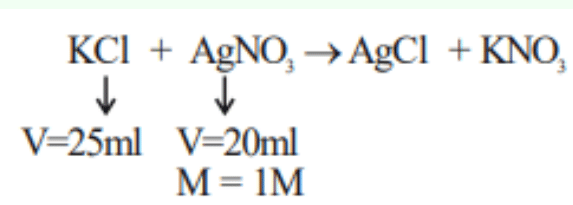
AgNO3+KClAgCl+KNO3\text{AgNO}_3 + \text{KCl} \rightarrow \text{AgCl} + \text{KNO}_3

The stoichiometric ratio of AgNO3{}_3 and KCl is 1:11:1.

Moles of AgNO3{}_3 used:

n=M×V=1×0.020=0.020  moln = M \times V = 1 \times 0.020 = 0.020 \; \text{mol}

Therefore, moles of KCl in 25mL25 \, \text{mL} solution are also

0.020  mol0.020 \; \text{mol}

Using density 1gmL11 \, g \, mL^{-1}, mass of solution is

25  g25 \; \text{g}

For this dilute solution, mass of solvent is taken approximately as

25  g=0.025  kg25 \; \text{g} = 0.025 \; \text{kg}

Molality of KCl:

m=0.0200.025=0.8  mol kg1m = \frac{0.020}{0.025} = 0.8 \; \text{mol kg}^{-1}

Since KCl dissociates completely into K+K^+ and ClCl^-, the van 't Hoff factor is

i=2i = 2

Hence,

ΔTf=iKfm=2×2.0×0.8=3.2  K\Delta T_f = iK_f m = 2 \times 2.0 \times 0.8 = 3.2 \; K

The nearest integer is 33. Therefore, the depression in freezing point is 3K3 \, K.

Detailed Working from Titration Data

Given: At equivalence point, millimoles of KCl equal millimoles of AgNO3{}_3.

Find: The numerical value of ΔTf\Delta T_f.

Reaction sketch showing KCl reacting with AgNO3 to form AgCl and KNO3, with KCl solution volume 25 mL and AgNO3 volume 20 mL of 1 M indicated.

At equivalence point,

mmole of KCl=mmole of AgNO3\text{mmole of KCl} = \text{mmole of AgNO}_3

So,

moles of KCl=20×103  mol\text{moles of KCl} = 20 \times 10^{-3} \; \text{mol}

Volume of solution = 25mL25 \, \text{mL}

Mass of solution = 25g25 \, \text{g}

Mass of solvent:

=25[20×103×74.5]= 25 - \left[20 \times 10^{-3} \times 74.5\right] =23.51  g= 23.51 \; \text{g}

Molality of KCl:

m=20×10323.51×103=0.85m = \frac{20 \times 10^{-3}}{23.51 \times 10^{-3}} = 0.85

For 100% ionisation of KCl,

i=2i = 2

Now,

ΔTf=i×Kf×m\Delta T_f = i \times K_f \times m =2×2×0.85= 2 \times 2 \times 0.85 =3.4= 3.4 3\approx 3

Therefore, the correct numerical answer is 33.

Common mistakes

  • Using molarity directly in the freezing point formula is incorrect because depression in freezing point depends on molality, not molarity. First convert the titration result into moles and divide by mass of solvent in kg.

  • Taking van 't Hoff factor as 11 is wrong. KCl dissociates completely into K+K^+ and ClCl^-, so for 100% ionization use i=2i = 2.

  • Confusing the 25mL25 \, \text{mL} sample volume with solvent mass directly without using density causes unit errors. Use density 1gmL11 \, g \, mL^{-1} to convert solution volume into mass before estimating solvent mass.

Practice more Colligative Properties questions

Get unlimited AI-adaptive practice, mastery tracking, and an AI tutor that explains every step — free to start.

Related questions