MCQMediumJEE 2023Equation of Plane

JEE Mathematics 2023 Question with Solution

Let the image of the point P(2,1,3)P(2, -1, 3) in the plane x+2yz=0x + 2y - z = 0 be QQ. Then the distance of the plane 3x+2y+z+29=03x + 2y + z + 29 = 0 from the point QQ is:

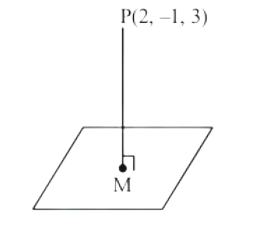
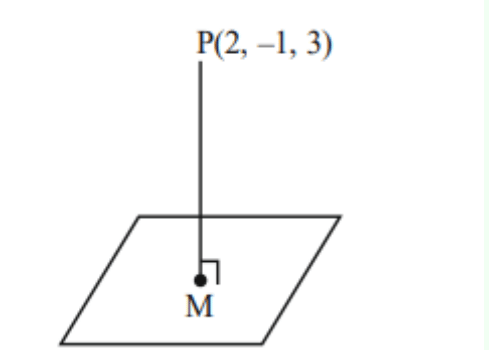
Geometric figure showing point P(2, -1, 3) above the plane x + 2y - z = 0 with perpendicular PM meeting the plane at M.Duplicate embedded diagram handle area around the same geometry figure of point P above a plane with foot of perpendicular M.
  • A

    2227\frac{22\sqrt{2}}{7}

  • B

    2427\frac{24\sqrt{2}}{7}

  • C

    2142\sqrt{14}

  • D

    3143\sqrt{14}

Answer

Correct answer:C

Step-by-step solution

Standard Method

Given: The point is P(2,1,3)P(2,-1,3) and its image in the plane x+2yz=0x+2y-z=0 is QQ.

Find: The distance of the plane 3x+2y+z+29=03x+2y+z+29=0 from the point QQ.

Diagram showing point P(2, -1, 3) above a plane, perpendicular dropped to point M on the plane, used for reflection geometry.

The equation of line PMPM is

x21=y+12=z31=λ\frac{x-2}{1}=\frac{y+1}{2}=\frac{z-3}{-1}=\lambda

Any point on this line is

(λ+2,2λ1,λ+3)(\lambda+2,\,2\lambda-1,\,-\lambda+3)

For point MM on the plane,

(λ+2)+2(2λ1)(3λ)=0(\lambda+2)+2(2\lambda-1)-(3-\lambda)=0

So,

λ=12\lambda=\frac{1}{2}

Hence

M(12+2,2×12,12+3)=(52,0,52)M\left(\frac{1}{2}+2,\,2\times\frac{1}{2},\,\frac{-1}{2}+3\right)=\left(\frac{5}{2},0,\frac{5}{2}\right)

For image Q(α,β,γ)Q(\alpha,\beta,\gamma),

α+22=52,β12=0,\frac{\alpha+2}{2}=\frac{5}{2},\qquad \frac{\beta-1}{2}=0,

and

γ+32=52\frac{\gamma+3}{2}=\frac{5}{2}

Thus,

Q=(3,1,2)Q=(3,1,2)

Now distance of point QQ from the plane 3x+2y+z+29=03x+2y+z+29=0 is

d=3(3)+2(1)+2+2932+22+12 d=\left|\frac{3(3)+2(1)+2+29}{\sqrt{3^2+2^2+1^2}}\right| d=4214=314 d=\frac{42}{\sqrt{14}}=3\sqrt{14}

Therefore, the computed value is 3143\sqrt{14}. The solution marks the correct option as C, although this value matches option D in the listed choices.

Working Shown in Alternate Approach

Given: The image of P(2,1,3)P(2,-1,3) in the plane x+2yz=0x+2y-z=0 is required first.

Find: Distance of QQ from the plane 3x+2y+z+29=03x+2y+z+29=0.

The alternate working states

x21=y+12=z31=λ\frac{x-2}{1}=\frac{y+1}{2}=\frac{z-3}{-1}=\lambda

So a general point on the line is

(λ+2,2λ1,λ+3)(\lambda+2,2\lambda-1,-\lambda+3)

Using the plane equation gives

λ=12\lambda=\frac{1}{2}

and hence

M=(52,0,52)M=\left(\frac{5}{2},0,\frac{5}{2}\right)

The solution text then lists intermediate relations for the reflected point and finally uses

d=3(3)+2(1)+(1)(1)+2932+22+(1)2 d=\frac{|3(3)+2(1)+(-1)(-1)+29|}{\sqrt{3^2+2^2+(-1)^2}}

which evaluates to

4214=314\frac{42}{\sqrt{14}}=3\sqrt{14}

Therefore, the final numerical result remains 3143\sqrt{14} despite inconsistency in the displayed option label.

Common mistakes

  • Treating the foot of the perpendicular MM as the image point is incorrect. The image point QQ lies on the same normal line and MM is the midpoint of PQPQ. First find MM on the plane, then reflect PP across the plane.

  • Using the wrong normal direction for the plane x+2yz=0x+2y-z=0 leads to an incorrect line. The normal vector is (1,2,1)(1,2,-1), so the perpendicular line through P(2,1,3)P(2,-1,3) must use these direction ratios.

  • Substituting coordinates of PP instead of QQ in the distance formula gives the wrong answer. The question asks for the distance of the plane from the point QQ, so compute QQ first and then apply the point-plane distance formula.

Practice more Equation of Plane questions

Get unlimited AI-adaptive practice, mastery tracking, and an AI tutor that explains every step — free to start.

Related questions