
A sample of a metal oxide has formula .
The metal can exist in two oxidation states and . In the sample of , the percentage of metal ions existing in the oxidation state is _____ % (nearest integer).
A sample of a metal oxide has formula .
The metal can exist in two oxidation states and . In the sample of , the percentage of metal ions existing in the oxidation state is _____ % (nearest integer).
Correct answer:59
Standard Method
Given: The oxide has formula . Metal exists as and .
Find: The percentage of metal ions in the oxidation state.
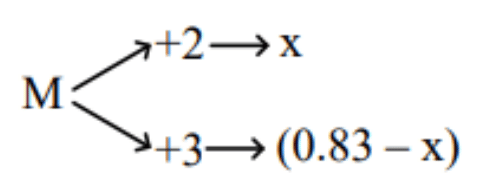
Let the amount of metal in the oxidation state be , and the amount in the oxidation state be .
From the charge balance equation:
Simplifying the equation:
Thus, the percentage of metal ions in the oxidation state is:
Therefore, the percentage of metal ions in the oxidation state is , so the required numerical answer is 59.
Alternative Extracted Working
Given: The oxide composition is .
Find: Percentage of metal present as .
The extracted solution states that on solving
we get , and then the percentage is reported as .
Using the extracted value , the percentage of ions is
So, the correct numerical answer is 59.
Note: The second approach text contains an internal inconsistency in the written fraction, but the concluded answer is still reported as .
Using the total metal amount as instead of is incorrect because the formula explicitly gives only mole of metal per mole of oxygen. Always define the amounts from the given formula first.
Writing the charge balance incorrectly can lead to a wrong proportion. Oxygen contributes negative charge, so the positive charge from metal ions must balance it through the stated oxidation states.
Finding and treating it directly as is wrong because is the amount of ions, not the fraction of total metal ions. Divide by total metal amount before multiplying by .
Get unlimited AI-adaptive practice, mastery tracking, and an AI tutor that explains every step — free to start.