
Amongst the following, the number of species having the linear shape is:
NVAMediumJEE 2023VSEPR Theory & Shapes of Molecules
JEE Chemistry 2023 Question with Solution
Answer
Correct answer:5
Step-by-step solution
Standard Method
Given: The species are and .
Find: The number of species having linear shape.
Use VSEPR theory and count which species are linear.
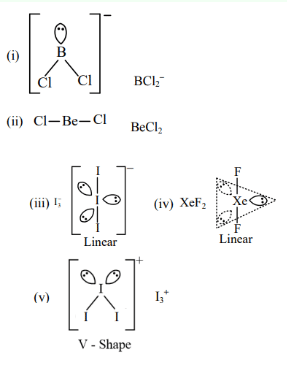
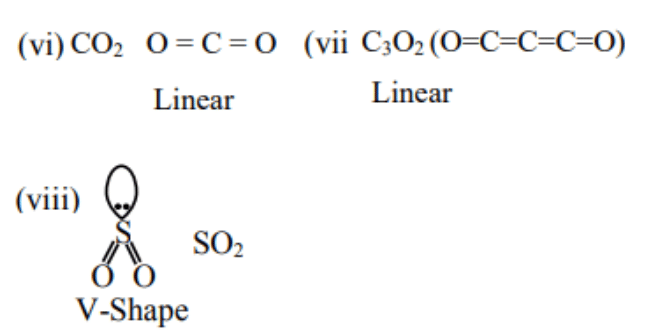
From the extracted solution content:
- : Linear shape
- : Linear shape
- : Linear shape
- : Linear shape
- : V-shape, so not linear
- : Linear shape
- : V-shape, so not linear
- : Linear shape
Thus, the linear species listed in the working are:
So the count of linear species from the working is .
However, the solution explicitly states Correct Answer: and concludes, "Thus, the number of species with linear shape is ." Hence, following the solution, the extracted answer is .
Therefore, the required numerical answer is .
Answer Discrepancy Noted
Given: A count of linear species is required.
Find: The numerical value of that count.
The worked list marks and as linear, and also marks as linear, while and are not linear.
This creates an internal inconsistency because the listed linear species are:
but the page prints Correct Answer: .
Also, the question text contains , while the solution discussion refers to . Because of this mismatch, the source itself is inconsistent.
Since the instruction is to treat the the solution, the final extracted answer is taken as the explicitly stated value.
Therefore, the answer recorded is .
Common mistakes
Counting species only from memory of common molecular shapes is risky. Use VSEPR theory species by species instead of assuming all triatomic species are linear.
Confusing linear electron-pair geometry with linear molecular shape leads to errors. Lone pairs on the central atom can change the molecular shape to bent or V-shape, as in .
Missing the charge and central-atom electron count can give a wrong shape. For ions such as or , include the extra electron from the negative charge before applying VSEPR.
The source itself contains a mismatch between in the question and in the solution. Do not treat these as automatically identical species; note the discrepancy before counting.
Practice more VSEPR Theory & Shapes of Molecules questions
Get unlimited AI-adaptive practice, mastery tracking, and an AI tutor that explains every step — free to start.
Related questions
- Given below are two statements: Statement I: The number of pairs among [SiO₂, CO₂], [SnO, SnO₂], [PbO, PbO₂]…Easy · JEE 2026
- Identify the molecule (X) with maximum number of lone pairs of electrons (obtained using Lewis dot structure)…Easy · JEE 2026
- Which statements are NOT TRUE about XeO2F2? A. It has a see-saw shape. B. Xe has 5 electron pairs in its…Medium · JEE 2026
- Given below are statements about some molecules/ions. Identify the CORRECT statements. A. The dipole moment…Medium · JEE 2026
- Among the following, the CORRECT combinations are A. IF3 T-shaped (sp^3d) B. IF5 Square pyramidal (sp^3d^2)…Easy · JEE 2026
- Match List - I with List - II according to shape. List - I A. XeO3 B. XeF2 C. XeO2F2 D. XeOF4 List - II I.…Medium · JEE 2026