NVAEasyJEE 2023Equation of Plane

JEE Mathematics 2023 Question with Solution

Let θ\theta be the angle between the planes

P1:r(i^+j^+2k^)=9andP2:r(2i^j^+k^)=15.P_1: \vec{r} \cdot ( \hat{i} + \hat{j} + 2 \hat{k}) = 9 \quad \text{and} \quad P_2: \vec{r} \cdot (2 \hat{i} - \hat{j} + \hat{k}) = 15.

Let LL be the line that meets P2P_2 at the point (4,2,5)(4, -2, 5) and makes an angle θ\theta with the normal of P2P_2. If α\alpha is the angle between LL and P2P_2, then

(tan2θ)(cot2α)(\tan^2 \theta)(\cot^2 \alpha)

is equal to:

Answer

Correct answer:9

Step-by-step solution

Standard Method

Given: The normals to the planes are i^+j^+2k^\hat{i} + \hat{j} + 2\hat{k} and 2i^j^+k^2\hat{i} - \hat{j} + \hat{k}.

Find: The value of (tan2θ)(cot2α)(\tan^2\theta)(\cot^2\alpha).

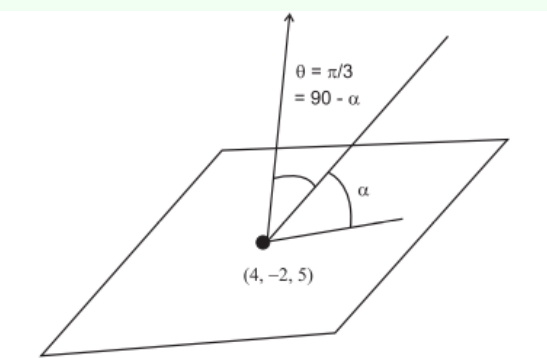
A line through the point (4, -2, 5) intersects a plane, with angle alpha to the plane and theta equal to pi by 3 shown between the line and the normal.

Using the angle between the normals of the two planes,

cosθ=(i^+j^+2k^)(2i^j^+k^)i^+j^+2k^2i^j^+k^\cos \theta = \frac{(\hat{i}+\hat{j}+2\hat{k})\cdot(2\hat{i}-\hat{j}+\hat{k})}{\left|\hat{i}+\hat{j}+2\hat{k}\right|\left|2\hat{i}-\hat{j}+\hat{k}\right|} =21+212+12+2222+(1)2+12=366=12= \frac{2-1+2}{\sqrt{1^2+1^2+2^2}\,\sqrt{2^2+(-1)^2+1^2}} = \frac{3}{\sqrt{6}\,\sqrt{6}} = \frac{1}{2}

Hence,

θ=π3\theta = \frac{\pi}{3}

The angle between a line and a plane is complementary to the angle between the line and the plane's normal. Since the line makes angle θ\theta with the normal of P2P_2,

α=π2θ=π2π3=π6\alpha = \frac{\pi}{2} - \theta = \frac{\pi}{2} - \frac{\pi}{3} = \frac{\pi}{6}

Now,

tan2θ=tan2π3=(3)2=3\tan^2 \theta = \tan^2 \frac{\pi}{3} = (\sqrt{3})^2 = 3

and

cot2α=cot2π6=(3)2=3\cot^2 \alpha = \cot^2 \frac{\pi}{6} = (\sqrt{3})^2 = 3

Therefore,

(tan2θ)(cot2α)=3×3=9(\tan^2 \theta)(\cot^2 \alpha) = 3 \times 3 = 9

Therefore, the required numerical value is 99.

Using plane normals and complementary angles

Given: P1:r(i^+j^+2k^)=9P_1: \vec{r} \cdot ( \hat{i} + \hat{j} + 2 \hat{k}) = 9 and P2:r(2i^j^+k^)=15P_2: \vec{r} \cdot (2 \hat{i} - \hat{j} + \hat{k}) = 15.

Find: (tan2θ)(cot2α)(\tan^2 \theta)(\cot^2 \alpha) where θ\theta is the angle between the planes and the line makes angle θ\theta with the normal of P2P_2.

The angle between two planes equals the angle between their normal vectors. So take

n1=i^+j^+2k^,n2=2i^j^+k^\vec{n}_1 = \hat{i} + \hat{j} + 2\hat{k}, \qquad \vec{n}_2 = 2\hat{i} - \hat{j} + \hat{k}

Then

n1n2=(1)(2)+(1)(1)+(2)(1)=3\vec{n}_1 \cdot \vec{n}_2 = (1)(2) + (1)(-1) + (2)(1) = 3

Also,

n1=12+12+22=6,n2=22+(1)2+12=6|\vec{n}_1| = \sqrt{1^2+1^2+2^2} = \sqrt{6}, \qquad |\vec{n}_2| = \sqrt{2^2+(-1)^2+1^2} = \sqrt{6}

Therefore,

cosθ=366=36=12\cos\theta = \frac{3}{\sqrt{6}\sqrt{6}} = \frac{3}{6} = \frac{1}{2}

So,

θ=π3\theta = \frac{\pi}{3}

Now the line makes angle θ\theta with the normal of P2P_2. If α\alpha is the angle between the line and the plane P2P_2, then

α+θ=π2\alpha + \theta = \frac{\pi}{2}

Thus,

α=π6\alpha = \frac{\pi}{6}

Hence,

tan2θ=tan2π3=3,cot2α=cot2π6=3\tan^2\theta = \tan^2\frac{\pi}{3} = 3, \qquad \cot^2\alpha = \cot^2\frac{\pi}{6} = 3

So,

(tan2θ)(cot2α)=33=9(\tan^2\theta)(\cot^2\alpha) = 3 \cdot 3 = 9

Therefore, the answer is 99.

The second provided approach concludes 8181, but that comes from incorrectly taking tan2π3=9\tan^2\frac{\pi}{3} = 9 and cot2π6=9\cot^2\frac{\pi}{6} = 9. The correct values are both 33, so the correct result remains 99.

Common mistakes

  • Using the angle between the planes incorrectly. The angle between two planes is the angle between their normal vectors, not between arbitrary directions lying in the planes. Always extract the normals first from the plane equations.

  • Forgetting that the angle between a line and a plane is complementary to the angle between the line and the plane's normal. Here α=π2θ\alpha = \frac{\pi}{2} - \theta, not α=θ\alpha = \theta.

  • Evaluating trigonometric squares wrongly. tanπ3=3\tan \frac{\pi}{3} = \sqrt{3} and cotπ6=3\cot \frac{\pi}{6} = \sqrt{3}, so their squares are 33, not 99. Square the trigonometric value after computing it correctly.

Practice more Equation of Plane questions

Get unlimited AI-adaptive practice, mastery tracking, and an AI tutor that explains every step — free to start.

Related questions