
If the domain of the function ](streamdown:incomplete-link)
- A
- B
- C
- D
If the domain of the function ](streamdown:incomplete-link)
Correct answer:A
Standard Method
Given: with domain .
Find: The range of the function.](streamdown:incomplete-link)
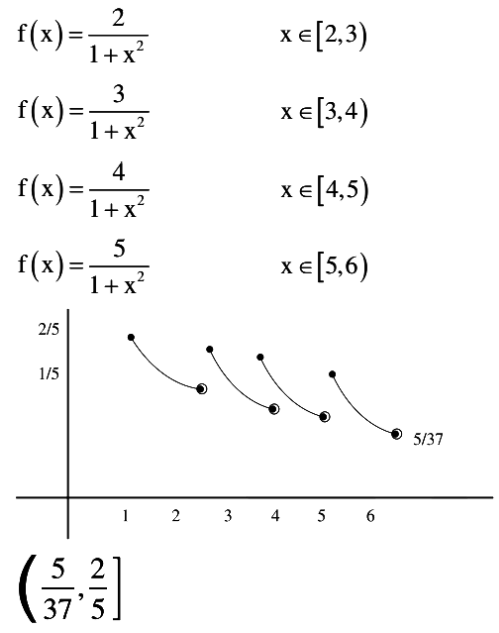
From the solution, the function behaves piecewise as
f(x)=\frac{5}{1+x^2}, \quad x \in [5,6) $$](streamdown:incomplete-link)On each interval, the numerator is constant and the denominator increases as increases, so each branch is decreasing.
Therefore, the largest value occurs at :
This value is included because .](streamdown:incomplete-link)
The smallest value is approached on the interval as :
Since is not included, is not attained.](streamdown:incomplete-link)
Hence the range is
So, the correct option is A.
The listed raw options contain a mismatch with the source correct-answer field, but the solution explicitly concludes option A with range .
Interval-wise Interpretation
Given: The greatest integer function changes value at integers.
Find: How the range is formed over the domain .](streamdown:incomplete-link)
Break the domain into intervals where is constant:
This gives four decreasing branches. Their endpoint values are:
\frac{5}{37} < f(x) \le \frac{5}{26} \quad \text{on } [5,6) $$](streamdown:incomplete-link)Combining these intervals, the overall highest value is and the overall lowest approached value is , not included.
Therefore, the range is , which matches Option A.
Assuming is constant on the whole domain. This is wrong because it changes at each integer. Split into first.](streamdown:incomplete-link)
Including in the range. This is wrong because it corresponds to , and is not in the domain. Treat it as a lower limit only.
Using only endpoint substitution without checking monotonicity on each interval. Since the denominator increases with , each branch decreases, which determines the interval endpoints correctly.
Get unlimited AI-adaptive practice, mastery tracking, and an AI tutor that explains every step — free to start.