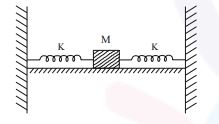
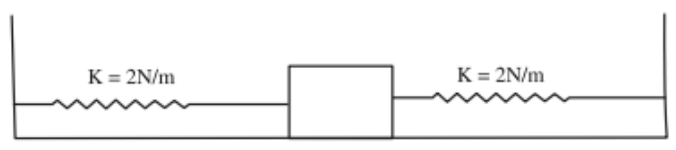
In the figure given below, a block of mass M=490g is placed on a frictionless table is connected with two springs having the same spring constant (K=2N/m). If the block is horizontally displaced through X m, then the number of complete oscillations it will make in 14t seconds will be:
Answer
Correct answer:20
Step-by-step solution
Standard Method
Given: Mass of the block is m=490g=0.49kg and each spring has spring constant K=2N/m.
Find: Number of complete oscillations in the given time interval.
Since both springs act together, the effective spring constant is
Keff=K+K=2K=2×2=4N/m
The time period of oscillation is
T=2πKeffm
Substituting the values,
T=2π40.49=2π40049=2π×207=107πs
The number of oscillations in the given time interval is
N=Ttime=7π/1014π=20
Therefore, the number of complete oscillations is 20.
Using the extracted working
Given: Two identical springs of constant K=2N/m are attached to a block of mass 490g.
Find: The number of complete oscillations made in the stated time.
When two springs are connected in parallel, their spring constants add:
Keff=K+K=2k=4N/m
Also,
m=490g=0.49kg
Now,
T=2πKeffm=2π40.49=2π49400−1=2π⋅207=107π
Using the solution conclusion,
N=7π/1014π=20
So the final numerical answer is 20.
Common mistakes
Treating the two springs as if they were in series. That is wrong because the block moves with both springs acting simultaneously, so the effective spring constant is the sum. Use Keff=K+K.
Forgetting to convert mass from grams to kilograms. Using 490 instead of 0.49kg gives an incorrect time period. Always convert to SI units before substitution.
Using amplitude X in the time period formula. For ideal SHM of a spring-block system, the time period does not depend on amplitude. Use only m and Keff.
Practice more Simple Harmonic Motion (SHM) questions
Get unlimited AI-adaptive practice, mastery tracking, and an AI tutor that explains every step — free to start.