
Let be the area of the region .Then is equal to .....
NVAMediumJEE 2023Applications of Integrals (Area)
JEE Mathematics 2023 Question with Solution
Answer
Correct answer:25
Step-by-step solution
Standard Method
Given: The region is defined by
Find: The value of , where is the enclosed area.
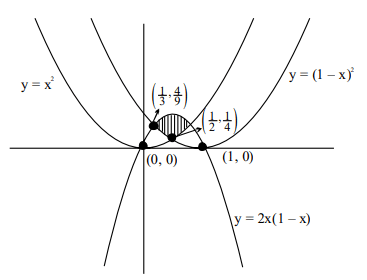
The lower boundary is the upper envelope of and . By symmetry, the area can be written as
Now simplify the integrand:
So,
Integrating,
Evaluate the bracket:
Therefore,
Hence,
Therefore, the required value is .
Piecewise Boundary Method
Given: The same bounded region with upper curve and lower boundary equal to .
Find: .
First find where the top curve meets the lower curves. For and ,
So or .
For and ,
This gives intersections at and . The bounded common region exists for
Now the lower boundary changes at :
- for , lower curve is
- for , lower curve is
So,
For the first integral,
Hence,
For the second integral,
Hence,
Therefore,
Thus,
Therefore, the required value is .
Common mistakes
Taking the lower boundary as or throughout the interval is incorrect. The condition and means the lower boundary is , which changes at .
Using the wrong interval of integration is a common error. The common region exists only where , which leads to .
While using symmetry, students sometimes double the wrong half-interval. Symmetry is valid here, but it must be applied to an interval such as where the lower curve is clearly . Otherwise the integrand becomes incorrect.
Practice more Applications of Integrals (Area) questions
Get unlimited AI-adaptive practice, mastery tracking, and an AI tutor that explains every step — free to start.
Related questions
- The area of the region, inside the ellipse x^2+4y^2=4 and outside the region bounded by the curves y=x-1 and…Medium · JEE 2026
- If the area of the region (x, y): 1 - 2x y 4 - x^2, x 0, y 0 is,, N, (,) = 1, then the value of ( +) is:Medium · JEE 2026
- Let the line x = -1 divide the area of the region (x,y): 1 + x^2 y 3 - x in the ratio m:n, where (m,n)=1.…Medium · JEE 2026
- The area of the region A = (x,y): 4x^2 + y^2 8 and y^2 4x isMedium · JEE 2026
- Let the area of the region bounded by the curve y = x, x, lines x = 0, x = 3 /2, and the x-axis be A. Then, A…Medium · JEE 2026
- The area of the region enclosed between the circles x^2 + y^2 = 4 and x^2 + (y - 2)^2 = 4 is:Medium · JEE 2026