NVAMediumJEE 2023Coordinates in 3D

JEE Mathematics 2023 Question with Solution

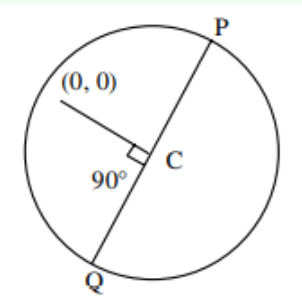
Let P(a1,b1)P(a_1, b_1) and Q(a2,b2)Q(a_2, b_2) be two distinct points on a circle with center C(2,3)C(\sqrt{2}, \sqrt{3}). Let OO be the origin and OCOC be perpendicular to both CPCP and CQCQ. If the area of the triangle OPCOPC is 352\frac{\sqrt{35}}{2}, then a12+a22+b12+b22a_1^2 + a_2^2 + b_1^2 + b_2^2 is equal to _____

A circle with center C, points P and Q on the circle, origin O marked as (0,0), and OC perpendicular to chord PQ with a right angle of 90 degrees shown at C.

Answer

Correct answer:24

Step-by-step solution

Standard Method

Given: C(2,3)C(\sqrt{2}, \sqrt{3}) is the center of the circle, so

OC=(2)2+(3)2=5OC = \sqrt{(\sqrt{2})^2 + (\sqrt{3})^2} = \sqrt{5}

Also, OCCPOC \perp CP and the area of triangle OPCOPC is

12×PC×5=352\frac{1}{2} \times PC \times \sqrt{5} = \frac{\sqrt{35}}{2}

Find: a12+a22+b12+b22a_1^2 + a_2^2 + b_1^2 + b_2^2.

From

12×PC×5=352\frac{1}{2} \times PC \times \sqrt{5} = \frac{\sqrt{35}}{2}

we get

PC=7PC = \sqrt{7}

Since PP and QQ lie on the same circle centered at CC,

CP=CQ=7CP = CQ = \sqrt{7}

Now,

a12+b12+a22+b22=OP2+OQ2a_1^2 + b_1^2 + a_2^2 + b_2^2 = OP^2 + OQ^2

Using the right triangle relation shown in the working,

OP2=OC2+CP2=5+7OP^2 = OC^2 + CP^2 = 5 + 7

and similarly,

OQ2=OC2+CQ2=5+7OQ^2 = OC^2 + CQ^2 = 5 + 7

Therefore,

OP2+OQ2=2(5+7)=24OP^2 + OQ^2 = 2(5+7) = 24

So, the required value is 2424.

A circle with center C, points P and Q on the circle, origin O marked as (0,0), and OC perpendicular to chord PQ with a right angle of 90 degrees shown at C.

Geometric Interpretation

Given: OCOC is perpendicular to both CPCP and CQCQ, with OC=5OC = \sqrt{5} and area of triangle OPCOPC equal to 352\frac{\sqrt{35}}{2}.

Find: The value of OP2+OQ2OP^2 + OQ^2.

Because C(2,3)C(\sqrt{2}, \sqrt{3}),

OC2=(2)2+(3)2=2+3=5OC^2 = (\sqrt{2})^2 + (\sqrt{3})^2 = 2+3 = 5

Hence,

OC=5OC = \sqrt{5}

The area condition gives

12×OC×PC=352\frac{1}{2} \times OC \times PC = \frac{\sqrt{35}}{2}

so

12×5×PC=352\frac{1}{2} \times \sqrt{5} \times PC = \frac{\sqrt{35}}{2}

and therefore

PC=7PC = \sqrt{7}

Since PP and QQ are on the same circle with center CC,

CP=CQ=7CP = CQ = \sqrt{7}

Now triangle OCPOCP is right-angled at CC, so

OP2=OC2+CP2=5+7=12OP^2 = OC^2 + CP^2 = 5+7 = 12

Similarly,

OQ2=OC2+CQ2=5+7=12OQ^2 = OC^2 + CQ^2 = 5+7 = 12

Thus,

OP2+OQ2=12+12=24OP^2 + OQ^2 = 12+12 = 24

Therefore, the correct answer is 2424.

Common mistakes

  • Using PCPC as the perpendicular distance in the area formula without first noting that OCCPOC \perp CP. The area must be formed from two perpendicular sides of triangle OPCOPC, so use 12×OC×PC\frac{1}{2} \times OC \times PC.

  • Computing OCOC incorrectly from the center coordinates. Since C(2,3)C(\sqrt{2}, \sqrt{3}), we have OC=2+3=5OC = \sqrt{2+3} = \sqrt{5}, not 2+3\sqrt{2} + \sqrt{3}.

  • Forgetting that a12+b12=OP2a_1^2 + b_1^2 = OP^2 and a22+b22=OQ2a_2^2 + b_2^2 = OQ^2. The required expression is the sum of squared distances from the origin, not the square of a sum of coordinates.

Practice more Coordinates in 3D questions

Get unlimited AI-adaptive practice, mastery tracking, and an AI tutor that explains every step — free to start.

Related questions