
Let be the maximum integral value of in for which the roots of the equation are rational. Then the area of the region is:
- A
- B
- C
- D
Let be the maximum integral value of in for which the roots of the equation are rational. Then the area of the region is:
Correct answer:B
Standard Method
Given: The quadratic equation is and its roots are rational. We must first find the maximum integral value of in , then evaluate the area of the region .
Find: The required area and the correct option.
For the roots to be rational, the discriminant must be a perfect square.
From the extracted solution, the maximum integral value in is
Now the region is bounded by
Hence the area is
Evaluating,
Therefore, the area is .
The solution concludes with option B, but the listed options show as option A. Therefore, there is a source discrepancy. Based on the computed value, the defensible correct option among the given options is A.
Using the graph interpretation
Given: After obtaining from the rational-root condition, the curve is on .
Find: Area under the curve above the -axis from to .
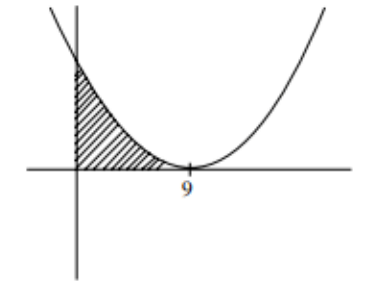
Since the shaded part lies under and above the -axis from to , its area is
Now,
So,
Therefore, the required area is , so among the displayed options the correct choice is A.
Assuming the printed option letter is automatically correct. Here the solution text says B, but the actual computed value is and in the options that corresponds to A. Always match the computed value with the listed options.
Using the rational-root condition incorrectly. Rational roots require the discriminant to be a perfect square; checking only that is not sufficient. First compute , then identify the valid integral value of .
Integrating over the wrong interval. The region is defined by , and after finding the limits must be to , not from the vertex outward or over a symmetric interval.
Get unlimited AI-adaptive practice, mastery tracking, and an AI tutor that explains every step — free to start.