Decreasing order towards reaction for the following compounds is:
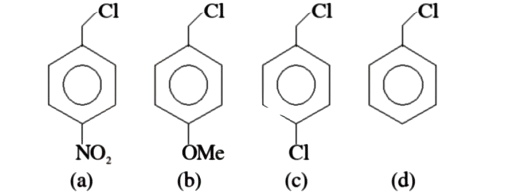
- A
a c d b
- B
a b c d
- C
b d c a
- D
d b c a
Decreasing order towards reaction for the following compounds is:

a c d b
a b c d
b d c a
d b c a
Correct answer:C
Standard Method
Given: Four substituted benzyl chlorides a, b, c, d are compared for their tendency towards reaction.
Find: The decreasing order of reactivity.
In an reaction, the rate depends on the stability of the carbocation formed after the leaving group departs.
The benzylic carbocation is stabilized or destabilized by the para substituent on the ring. The order shown in the solution is
Thus, the reactivity order towards reaction is .
Therefore, the correct option is C.

Carbocation Stability Basis
Given: rate follows carbocation stability.
Find: Which substituted benzyl chloride forms the most stable benzylic carbocation.
Hence the decreasing order is
So the correct option is C.
Assuming reactivity depends mainly on the strength of the bond is incorrect here. The dominant factor is carbocation stability after chloride leaves. Compare the substituted benzylic carbocations first.
Treating NO2 as if it stabilizes the benzylic carbocation is wrong. NO2 is strongly electron-withdrawing and destabilizes positive charge. Therefore compound a should be least reactive.
Ignoring the effect of the para substituent on resonance is a conceptual error. In benzylic systems, ring substituents strongly affect the cation through resonance and inductive effects. Use substituent effects to rank the intermediates.
Get unlimited AI-adaptive practice, mastery tracking, and an AI tutor that explains every step — free to start.