NVAMediumJEE 2023Rolling Motion & Rotational Kinematics

JEE Physics 2023 Question with Solution

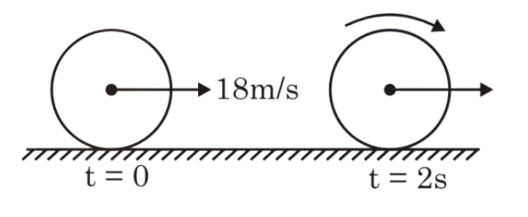
A uniform disc of mass 0.5kg0.5 \, \text{kg} and radius rr is projected with velocity 18m/s18 \, \text{m/s} at t=0t = 0 on a rough horizontal surface. It starts off with a purely sliding motion at t=0t = 0. After 2s2 \, \text{s}, it acquires a purely rolling motion (see figure). The total kinetic energy of the disc after 2s2 \, \text{s} will be ..... J (given, coefficient of friction is 0.30.3 and g=10m/s2g = 10 \, \text{m/s}^2).

A disc initially slides on a rough horizontal surface with center velocity 18 m/s at t = 0, and after t = 2 s it moves right while rotating, indicating pure rolling motion.

Answer

Correct answer:54

Step-by-step solution

Standard Method

Given: mass of disc m=0.5kgm = 0.5 \, \text{kg}, initial speed u=18m/su = 18 \, \text{m/s}, coefficient of friction μ=0.3\mu = 0.3, g=10m/s2g = 10 \, \text{m/s}^2, and the disc starts with pure sliding.

Find: total kinetic energy after 2s2 \, \text{s} when the disc acquires pure rolling motion.

Due to kinetic friction, the translational acceleration is

a=μg=3a = -\mu g = -3

So the speed after 2s2 \, \text{s} is

V=183×2V = 18 - 3 \times 2 V=12m/sV = 12 \, \text{m/s}

For a uniform disc in pure rolling motion,

KE=12mv2+12Iω2KE = \frac{1}{2}mv^2 + \frac{1}{2}I\omega^2

Using I=12mr2I = \frac{1}{2}mr^2 and ω=vr\omega = \frac{v}{r},

KE=12mv2+12(12mr2)(v2r2)KE = \frac{1}{2}mv^2 + \frac{1}{2}\left(\frac{1}{2}mr^2\right)\left(\frac{v^2}{r^2}\right) KE=34mv2KE = \frac{3}{4}mv^2

Substituting m=0.5m = 0.5 and v=12m/sv = 12 \, \text{m/s},

KE=34×0.5×122KE = \frac{3}{4} \times 0.5 \times 12^2 KE=54JKE = 54 \, \text{J}

Therefore, the total kinetic energy after 2s2 \, \text{s} is 54J54 \, \text{J}.

Energy Expression for Rolling Disc

Given: after 2s2 \, \text{s}, the disc is in pure rolling motion.

Find: how the total kinetic energy is written for a uniform disc.

The total kinetic energy is the sum of translational and rotational parts:

KE=12mv2+12Iω2KE = \frac{1}{2}mv^2 + \frac{1}{2}I\omega^2

For a uniform disc,

I=12mr2I = \frac{1}{2}mr^2

and for pure rolling,

ω=vr\omega = \frac{v}{r}

Hence,

KE=12mv2+12(12mr2)(vr)2KE = \frac{1}{2}mv^2 + \frac{1}{2}\left(\frac{1}{2}mr^2\right)\left(\frac{v}{r}\right)^2 KE=12mv2+14mv2=34mv2KE = \frac{1}{2}mv^2 + \frac{1}{4}mv^2 = \frac{3}{4}mv^2

Now with v=12m/sv = 12 \, \text{m/s} and m=0.5kgm = 0.5 \, \text{kg},

KE=34×0.5×144=54JKE = \frac{3}{4} \times 0.5 \times 144 = 54 \, \text{J}

Thus, the required value is 5454.

Common mistakes

  • Using only translational kinetic energy 12mv2\frac{1}{2}mv^2 is incorrect because after 2s2 \, \text{s} the disc is in pure rolling motion, so rotational kinetic energy must also be included. Use KE=12mv2+12Iω2KE = \frac{1}{2}mv^2 + \frac{1}{2}I\omega^2 instead.

  • Taking the speed after 2s2 \, \text{s} as unchanged at 18m/s18 \, \text{m/s} is wrong because friction produces a retardation. First calculate a=μga = -\mu g and then use v=u+atv = u + at.

  • Using the wrong moment of inertia is a common error. This body is a uniform disc, so I=12mr2I = \frac{1}{2}mr^2, not mr2mr^2 or 25mr2\frac{2}{5}mr^2. The kinetic energy depends on this choice.

Practice more Rolling Motion & Rotational Kinematics questions

Get unlimited AI-adaptive practice, mastery tracking, and an AI tutor that explains every step — free to start.

Related questions