
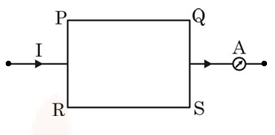
A current carrying rectangular loop PQRS is made of uniform wire. The length and . If ammeter current reading changes from to , the ratio of magnetic forces per unit length on the wire PQ due to wire RS in the two cases respectively is :
- A
- B
- C
- D
A current carrying rectangular loop PQRS is made of uniform wire. The length and . If ammeter current reading changes from to , the ratio of magnetic forces per unit length on the wire PQ due to wire RS in the two cases respectively is :
Correct answer:D
Standard Method
Given: A rectangular loop PQRS is made of uniform wire with and . The ammeter reading changes from to .
Find: The ratio of magnetic force per unit length on wire PQ due to wire RS in the two cases.
The solution states that the magnetic force per unit length varies as the square of current:
Therefore, when current changes from to ,
So,
the solution concludes that the correct option is D. However, among the given options, is listed as option B. Hence the worked result supports , and the matching option is B.
Answer Discrepancy Note
The provided solution text derives
but the solution says The Correct Option is D. Since option D in the listed options is , this conflicts with the actual derivation shown in the solution. Following the working, the defensible answer is B corresponding to .
Assuming the answer must follow the page label D without checking the worked result. This is wrong because the solution itself derives . Always match the final derived ratio with the listed options.
Taking force proportional to instead of . This is wrong because the magnetic field due to wire RS is proportional to current, and the force on wire PQ is also proportional to current, giving .
Using the rectangle dimensions unnecessarily in the ratio step. This is wrong here because the separation and geometry remain unchanged in both cases, so they cancel when forming the ratio. Focus on how force depends on current.
Get unlimited AI-adaptive practice, mastery tracking, and an AI tutor that explains every step — free to start.