
Two isolated metallic solid spheres of radii and are charged such that both have the same charge density . The spheres are then connected by a thin conducting wire. If the new charge density of the bigger sphere is , the ratio is:
- A
- B
- C
- D
Two isolated metallic solid spheres of radii and are charged such that both have the same charge density . The spheres are then connected by a thin conducting wire. If the new charge density of the bigger sphere is , the ratio is:
Correct answer:D
Standard Method
Given: Two isolated metallic solid spheres have radii and , and initially both have the same surface charge density .
Find: The ratio for the bigger sphere after connecting the spheres by a thin conducting wire.
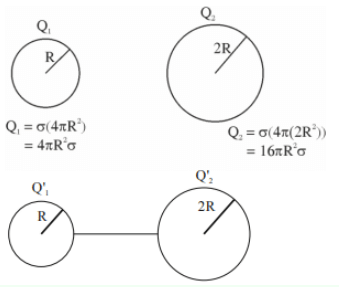
When the spheres are connected by a conducting wire, their potentials become equal. Therefore,
So,
Initially, the charges on the spheres are obtained from surface charge density:
Hence total charge is
Using conservation of charge,
Substitute :
Therefore,
Now the new surface charge density of the bigger sphere is
Hence,
Therefore, the correct option is D. The solution labels option C, but the worked result clearly gives , which matches option D.
Using equal charge instead of equal potential after connecting the spheres. Connected conductors redistribute charge until their potentials are equal, not their charges. Set , not .
Calculating initial charge with radius instead of surface area. Surface charge density is charge per unit area, so use . For the bigger sphere of radius , the area is , not .
Using the wrong area for the final charge density of the bigger sphere. After redistribution, . Forgetting the square on gives an incorrect ratio.
Get unlimited AI-adaptive practice, mastery tracking, and an AI tutor that explains every step — free to start.