
of is produced on complete combustion of gaseous mixture of ethene and methane at and . Heat evolved during the combustion process is _____ .
Given:
of is produced on complete combustion of gaseous mixture of ethene and methane at and . Heat evolved during the combustion process is _____ .
Given:
Correct answer:847.3
Standard Method
Given: Total gaseous mixture volume = , total produced = , , .
Find: Heat evolved during complete combustion.
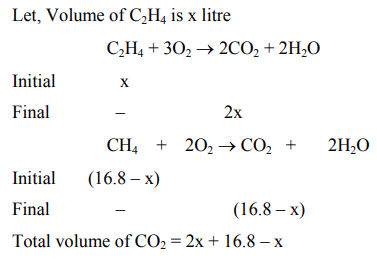
Let volume of be litre.
From combustion stoichiometry:
So litre of gives litre of .
For methane:
Hence litre of gives litre of .
Therefore, total volume of is
So volume of is and volume of is .
Now convert these gas volumes into moles using
For :
For :
Heat evolved is the sum of heats released by combustion of both gases:
Therefore, the heat evolved is .
The solution also shows a conflicting header value of , but the worked calculation concludes . Hence the defensible numerical answer from the working is .
Stoichiometric Volume Interpretation
Given: At the same temperature and pressure, gaseous volumes are proportional to moles.
Find: Composition of the mixture and total heat released.
If ethene volume is , methane volume is .
Because one volume of gives one volume of , while one volume of gives two volumes of , the total volume becomes
This is given as , so
Thus methane volume is
Using the molar heat of combustion values with the corresponding mole amounts gives the total heat released directly. This yields , so the numerical value answer is 847.3.
Assuming both gases produce the same volume of per unit volume is incorrect. gives twice its volume of , whereas gives an equal volume. Use combustion stoichiometry before forming the volume equation.
Using the negative signs of directly in the final 'heat evolved' value can lead to a sign error. The question asks for heat evolved, so report the magnitude of heat released, while recognizing combustion enthalpies are negative by convention.
Treating gas volumes as mole counts without checking that temperature and pressure are the same is risky. Here the gases are compared at the same conditions, so volume ratios can be used first, and then moles can be calculated consistently using if needed.
Get unlimited AI-adaptive practice, mastery tracking, and an AI tutor that explains every step — free to start.