
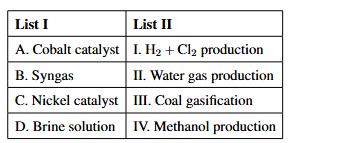
Match List I with List II:
- A
A-IV, B-I, C-II, D-III
- B
A-IV, B-III, C-I, D-II
- C
A-II, B-III, C-IV, D-I
- D
A-IV, B-III, C-II, D-I
Match List I with List II:
A-IV, B-I, C-II, D-III
A-IV, B-III, C-I, D-II
A-II, B-III, C-IV, D-I
A-IV, B-III, C-II, D-I
Correct answer:D
Standard Method
Given: A matching question between List I and List II.
Find: The correct correspondence between the four entries.
From the solution text:
The supporting reactions mentioned are:
for water gas related production, and electrolysis of brine gives hydrogen at cathode and chlorine at anode.
Thus the match is:
Therefore, the correct option is D.
Match Each Entry One by One
Given:
Find: Their correct matches in List II.
Cobalt catalyst is used in methanol production. Hence, A - IV.
Syngas is associated with coal gasification because coal gasification produces a mixture mainly containing CO and H$$$_2$$, called syngas. Hence, B - III.
Nickel catalyst is matched with water gas production. Hence, C - II.
Brine solution on electrolysis gives H_2$$** and **Cl_2$$. Hence, D - I.
Combining all matches: A-IV, B-III, C-II, D-I
Therefore, the correct option is D.
Matching syngas with water gas production directly is incorrect here because the solution identifies syngas with coal gasification. Use the process association given in the solution, not only a partial similarity in composition.
Confusing brine solution with ordinary salt solution without recalling electrolysis products leads to error. In brine electrolysis, hydrogen is formed at the cathode and chlorine at the anode, so it matches H_2$$ + Cl_2$$ production.
Assuming nickel catalyst must be linked to hydrogenation only can give a wrong match. According to the provided solution, it is matched with water gas production, so follow the source-specific industrial application.
Get unlimited AI-adaptive practice, mastery tracking, and an AI tutor that explains every step — free to start.