
A nucleus disintegrates into two smaller parts, which have their velocities in the ratio . The ratio of their nuclear sizes will be . The value of is:
NVAEasyJEE 2023Nuclear Fission & Fusion
JEE Physics 2023 Question with Solution
Answer
Correct answer:2
Step-by-step solution
Standard Method
Given: A nucleus disintegrates into two parts with velocity ratio
Find: The value of if the ratio of nuclear sizes is .
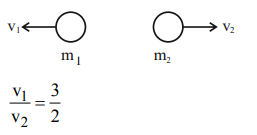
Using conservation of momentum for the two fragments:
Therefore,
Since nuclear mass density is constant, mass is proportional to volume. Hence,
So,
Thus,
Taking cube root,
Matching with the given form , we get
Therefore, the required value is .
Direct Proportionality Trick
Given:
Find: The value of in the size ratio expression.
From momentum conservation in two-body breakup,
so masses are inversely proportional to velocities. Hence,
For nuclei, radius varies as the cube root of mass:
Therefore,
Comparing with gives
The correct answer is .
Common mistakes
Using is incorrect. From momentum conservation, mass is inversely related through . First write the momentum equation, then form the correct mass ratio.
Assuming radius is directly proportional to mass is wrong. Nuclear radius follows because nuclear density is approximately constant. Convert mass ratio to radius ratio using cube root, not direct proportion.
Comparing the obtained ratio with carelessly can reverse numerator and denominator. After finding the radius ratio, match the inside of the bracket exactly before reading off .
Practice more Nuclear Fission & Fusion questions
Get unlimited AI-adaptive practice, mastery tracking, and an AI tutor that explains every step — free to start.
Related questions
- The average energy released per fission for the nucleus of ^23592U is 190 MeV. When all the atoms of 47 g…Easy · JEE 2026
- Match the LIST-I with LIST-II LIST-I LIST-II A. ^23692 U ^9438 Sr + ^14054 Xe + 2n I. Chemical Reaction B.…Easy · JEE 2025
- A nucleus at rest disintegrates into two smaller nuclei with their masses in the ratio 2:1. After…Easy · JEE 2024
- The energy released in the fusion of 2 kg of hydrogen deep in the sun is EH and the energy released in the…Medium · JEE 2024
- The explosive in a Hydrogen bomb is a mixture of ^21 H, ^31 H, and ^63 Li in some condensed form. The chain…Medium · JEE 2024
- A nucleus disintegrates into two nuclear parts, in such a way that ratio of their nuclear sizes is 1: 2^1/3.…Easy · JEE 2023