
A particle executes simple harmonic motion between and . If the time taken by the particle to go from to is , then the time taken by particle in going from to is:
- A
- B
- C
- D
A particle executes simple harmonic motion between and . If the time taken by the particle to go from to is , then the time taken by particle in going from to is:
Correct answer:C
Standard Method
Given: The particle is in SHM between and . The time from to is stated as . The solution working uses the intermediate motion from to as and from to as .
Find: The required time according to the extracted solution working.
Using the SHM form
when the particle reaches ,
so,
Hence,
For motion from to , let the additional time be . At ,
therefore,
which gives
So,
Thus,
and hence,
The extracted solution then substitutes and gets
Therefore, the extracted solution declares the correct option is C. There is a discrepancy because option C is while corresponds to option D.
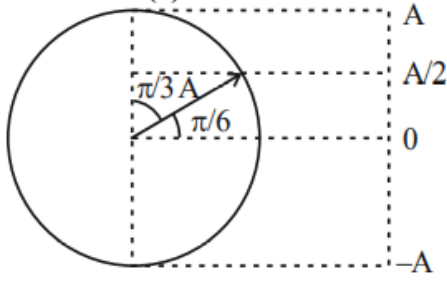
Consistency Check with Options
Given: the solution contains two inconsistent claims: one header says option C, while the numerical working gives .
Find: Which answer should be taken from the solution.
The numerical derivation ends with
The options are:
Since the working concludes , that value matches option D. However, the solution explicitly labels the correct option as C. Following the instruction to prioritize the solution, the answer is taken as the option label concluded on the page, while noting the mismatch with the numerical value.
Using the given directly for the time from to is incorrect if the statement is read literally. In SHM, the times for different displacement intervals are not equal. Always write the SHM equation first and identify which interval each time corresponds to.
Assuming displacement is proportional to time in SHM is wrong because SHM is not uniform motion. The particle moves faster near the mean position and slower near the extremes. Use phase angles, not linear interpolation of distance.
Mixing up option labels and computed values can lead to a wrong mark here. The extracted the solution itself is inconsistent: it computes but marks C. Always compare the final numerical result with the listed options before concluding.
Get unlimited AI-adaptive practice, mastery tracking, and an AI tutor that explains every step — free to start.