
Match List I with List II:
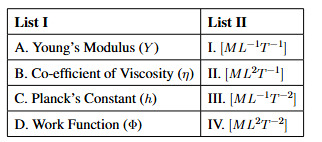
Choose the correct answer from the options given below:
- A
A-II, B-III, C-IV, D-I
- B
A-III, B-I, C-II, D-IV
- C
A-I, B-III, C-IV, D-II
- D
A-I, B-II, C-III, D-IV
Match List I with List II:
Choose the correct answer from the options given below:
A-II, B-III, C-IV, D-I
A-III, B-I, C-II, D-IV
A-I, B-III, C-IV, D-II
A-I, B-II, C-III, D-IV
Correct answer:B
Standard Method
Given: Match the physical quantities in List I with their dimensional formulas in List II.
Find: The correct correspondence and hence the correct option.
For Young's Modulus ,
Since strain is dimensionless, the dimensions of are the same as stress:
So, A (\rightarrow) III.
For co-efficient of viscosity , using
we get
Hence,
So, B (\rightarrow) I.
For Planck's constant , from
we have
Therefore,
So, C (\rightarrow) II.
For work function , it has the same dimensions as energy:
So, D (\rightarrow) IV.
Thus the matching is A-III, B-I, C-II, D-IV. Therefore, the correct option is B.
The solution labels the option as D, but its own written matching is A-III, B-I, C-II, D-IV, which corresponds to option B in the given choices.
Dimensional Matching
Given: Four physical quantities and four dimensional formulas.
Find: Which dimensional formula belongs to each quantity.
Hence A (\rightarrow) III.
So,
Hence B (\rightarrow) I.
Therefore,
Hence C (\rightarrow) II.
Hence D (\rightarrow) IV.
So the final matching is A-III, B-I, C-II, D-IV, giving option B.
Treating strain as having dimensions of length is incorrect because strain is a ratio and is dimensionless. Use only the dimensions of stress for Young's modulus.
Using instead of reverses the dimensions. Start from and isolate carefully.
Confusing frequency with time period can give the wrong dimension for Planck's constant. Use , not .
Get unlimited AI-adaptive practice, mastery tracking, and an AI tutor that explains every step — free to start.