
The osmotic pressure of solutions of PVC in cyclohexanone at are plotted on the graph. The molar mass of PVC is _____ (Nearest integer).
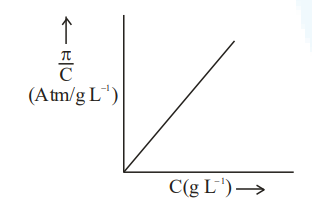
Given:
The osmotic pressure of solutions of PVC in cyclohexanone at are plotted on the graph. The molar mass of PVC is _____ (Nearest integer).
Given:
Correct answer:41500
Standard Method
Given: osmotic pressure data for PVC in cyclohexanone at , and .
Find: the molar mass of PVC.
For polymer solutions, osmotic pressure is related by
Hence,
So the graph of versus has slope
From the graph, the slope is
Therefore,
Now,
Therefore, the molar mass of PVC is .
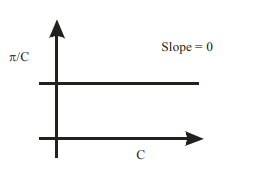
Using the graph relation explicitly
Given: the plotted graph is used to extract the proportionality between osmotic pressure and concentration.
Find: molar mass of PVC.
Starting with van't Hoff relation for dilute polymer solution,
Rearranging,
Thus is a function of , and equivalently for the straight-line interpretation used in the solution, the slope of the versus graph is
Using the slope read from the graph,
So,
Hence, the required nearest integer is 41500.
Using directly for molarity without accounting for polymer molar mass. This is wrong because for polymer solutions the concentration term must be related through . Instead, use the graph slope with .
Reading the graph slope as instead of . This gives a molar mass smaller by a factor of . Always check the graph scale carefully before substitution.
Rearranging the relation incorrectly to write . This is wrong because slope equals . Therefore, molar mass must be found from .
Get unlimited AI-adaptive practice, mastery tracking, and an AI tutor that explains every step — free to start.