
An object of mass initially at rest on a smooth horizontal plane starts moving under the action of force . In the process of its linear motion, the angle between the direction of force and horizontal varies as , where is a constant and is the distance covered by the object from its initial position. The expression of kinetic energy of the object will be . The value of is:
NVAMediumJEE 2023Work Done by Force
JEE Physics 2023 Question with Solution
Answer
Correct answer:2
Step-by-step solution
Work-Energy Method
Given: The object starts from rest on a smooth horizontal plane. The applied force has magnitude and the angle with the horizontal varies as .
Find: The value of in .
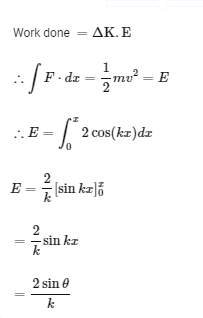
Using the work-energy theorem:
Only the horizontal component of force does work, so
Substituting and ,
Evaluating the integral,
Since ,
Comparing with , we get .
Therefore, the required value is .
Direct Component Trick
Given: and .
Find: The coefficient .
Since displacement is horizontal, directly take the working component of force as . Then kinetic energy gained equals work done:
Hence, comparing with , the correct value is .
Common mistakes
Taking the full force as doing work is incorrect because displacement is horizontal while the force is inclined. Only the horizontal component contributes to work.
Treating as constant is wrong because the question states . The angle changes with position, so the integrand must be written as before integrating.
Forgetting the lower limit at can lead to an unnecessary constant term. Use the definite integral from to so that is correctly included.
Practice more Work Done by Force questions
Get unlimited AI-adaptive practice, mastery tracking, and an AI tutor that explains every step — free to start.
Related questions
- A block of mass 25 kg is pulled along a horizontal surface by a force at an angle 45^ with the horizontal.…Medium · JEE 2025
- A force F = 2 i + b j + k is applied on a particle and it undergoes a displacement r = i - 2 j - k. What will…Easy · JEE 2025
- A force f = x^2 i + y j + y^2 k acts on a particle in a plane x + y = 10. The work done by this force during…Medium · JEE 2025
- A force F = + x^2 acts on an object in the x-direction. The work done by the force is 5 J when the object is…Easy · JEE 2025
- A force (3x^2 + 2x - 5) N displaces a body from x = 2 m to x = 4 m. The work done by this force is:Easy · JEE 2024
- A force F = (2 + 3x) i acts on a particle in the x-direction where F is in newton and x is in meter. The work…Easy · JEE 2023