NVAMediumJEE 2023Young's Modulus (Wire)

JEE Physics 2023 Question with Solution

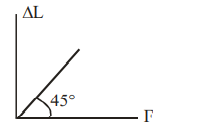
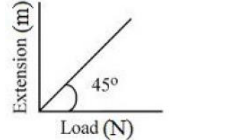
As shown in the figure, in an experiment to determine Young's modulus of a wire, the extension-load curve is plotted. The curve is a straight line passing through the origin and makes an angle of 4545^\circ with the load axis. The length of the wire is 62.8cm62.8 \, \text{cm} and its diameter is 4mm4 \, \text{mm}. The Young's modulus is found to be x×1010Nm2x \times 10^{10} \, Nm^{-2}. The value of xx is:

Graph of extension versus load with a straight line through the origin making an angle of 45 degrees with the load axis.

Answer

Correct answer:5

Step-by-step solution

Standard Method

Given: The extension-load graph is a straight line through the origin and makes an angle of 4545^\circ with the load axis. The wire length is 62.8cm62.8 \, \text{cm} and diameter is 4mm4 \, \text{mm}.

Find: The value of xx in Y=x×1010N m2Y = x \times 10^{10} \, \text{N m}^{-2}.

Extension versus load graph labelled ΔL and F, showing a straight line through the origin inclined at 45 degrees.

From graph:

F=ΔLF = \Delta L

Young's modulus is

Y=FLAΔLY = \frac{FL}{A\Delta L}

Using F=ΔLF = \Delta L,

Y=LAY = \frac{L}{A}

Now, radius of wire r=2×10³mr = 2 \times 10^{-3} \, \text{m}, so

A=πr2=π(2×10³)2A = \pi r^2 = \pi (2 \times 10^{-3})^2

Also,

L=62.8×10²mL = 62.8 \times 10^{-2} \, \text{m}

Therefore,

Y=62.8×10²π(2×10³)2Y = \frac{62.8 \times 10^{-2}}{\pi (2 \times 10^{-3})^2} Y=5×10¹⁰N/m2Y = 5 \times 10^{10} \, \text{N/m}^2

Therefore, the value of xx is 55.

Common mistakes

  • Using diameter in place of radius while calculating area. Since diameter is 4mm4 \, \text{mm}, the radius is 2mm2 \, \text{mm}. Use A=πr2A = \pi r^2 with r=2×10³mr = 2 \times 10^{-3} \, \text{m}.

  • Not interpreting the 4545^\circ slope correctly. Because the graph is between extension and load, slope =tan45=1= \tan 45^\circ = 1, so numerically ΔL=F\Delta L = F from the graph relation used in the solution.

  • Forgetting to convert centimetres and millimetres into SI units. Young's modulus must be calculated in N/m2\text{N/m}^2, so convert 62.8cm62.8 \, \text{cm} to metres and 4mm4 \, \text{mm} to metres before substitution.

Practice more Young's Modulus (Wire) questions

Get unlimited AI-adaptive practice, mastery tracking, and an AI tutor that explains every step — free to start.