MCQEasyJEE 2023Variation with Altitude & Depth

JEE Physics 2023 Question with Solution

Given below are two statements:

Statement I: Acceleration due to earth's gravity decreases as you go 'up' or 'down' from earth's surface.

Statement II: Acceleration due to earth's gravity is the same at a height hh and depth dd from earth's surface, if h=dh = d.

In the light of above statements, choose the most appropriate answer from the options given below:

  • A

    Statement I is incorrect but Statement II is correct

  • B

    Both Statement I and Statement II are incorrect

  • C

    Statement I is correct but Statement II is incorrect

  • D

    Both Statement I and Statement II are correct

Answer

Correct answer:A

Step-by-step solution

Standard Method

Given: Two statements about variation of acceleration due to gravity with height and depth.

Find: Which statement is correct.

For height above earth's surface, the solution states:

g=g(12hR)g' = g\left(1 - \frac{2h}{R}\right)

So, as hh increases, gg' decreases.

For depth below earth's surface, the solution states:

g=g(1dR)g' = g\left(1 - \frac{d}{R}\right)

So, as dd increases, gg' also decreases.

Therefore, Statement I is correct.

Now compare the values at equal height and depth, that is, when h=dh = d.

At height:

g=g(12hR)g' = g\left(1 - \frac{2h}{R}\right)

At depth:

g=g(1dR)g' = g\left(1 - \frac{d}{R}\right)

When h=dh = d, these two expressions are not equal because the decrease with height has coefficient 22, while the decrease with depth has coefficient 11.

Hence, Statement II is incorrect.

The solution explicitly concludes: Statement I is correct and Statement II is incorrect. This corresponds to the option text given as the third option. Although the solution labels it as A, that label is inconsistent with the listed options. Based on the option texts, the defensible correct choice is C.
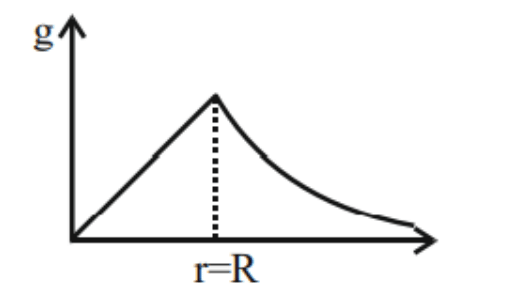

Graph of acceleration due to gravity g versus distance from Earth's center, rising linearly inside Earth to r equals R and then decreasing outside Earth.

Why equal height and depth do not give equal g

Given: Variation of gravity with height and depth.

Find: Whether equal values of hh and dd imply equal gravitational acceleration.

Inside the earth, the variation is linear:

g=g(1dR)g' = g\left(1 - \frac{d}{R}\right)

Above the surface, the variation is faster and is approximated by:

g=g(12hR)g' = g\left(1 - \frac{2h}{R}\right)

Now set

h=dh = d

Then the two expressions become

gheight=g(12hR)g'_{\text{height}} = g\left(1 - \frac{2h}{R}\right)

and

gdepth=g(1hR)g'_{\text{depth}} = g\left(1 - \frac{h}{R}\right)

These are unequal for any nonzero value of hh.

So the same distance upward and downward from the surface does not produce the same value of gravitational acceleration.

Therefore, the correct option is C.

Common mistakes

  • Assuming that equal height and equal depth must produce the same decrease in gg. This is wrong because gravity varies differently above the surface and inside the earth. Use the separate formulas for height and depth before comparing.

  • Thinking that going downward increases gg because you are moving closer to the earth's center. This is wrong inside the earth, where only the enclosed mass contributes effectively, causing gg to decrease with depth.

  • Choosing the option label directly from the solution without matching it to the listed options. Here the solution says option A, but its written conclusion matches the third listed option. Always verify using the option text.

Practice more Variation with Altitude & Depth questions

Get unlimited AI-adaptive practice, mastery tracking, and an AI tutor that explains every step — free to start.

Related questions